 Email: jiedong@sxrszdh.com
 Phone / Wechat:+86 15340683922
Description
Product Core Brief
A cement plant in Arizona had four encoders on the same kiln. The ground loop between them was so bad that the counters would drift whenever the mill motor started. The H1BAA killed the ground loops. The DS200FCGDH1BAA is the isolated high-speed counter board. Same four channels. Same 200 kHz maximum frequency. Same hardware latch. But each input channel has its own isolated front end — 1500 VAC isolation between channels and from the backplane.
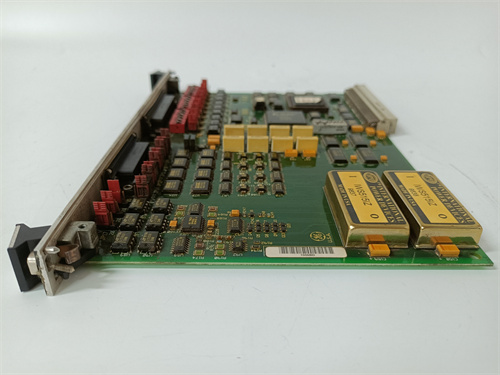
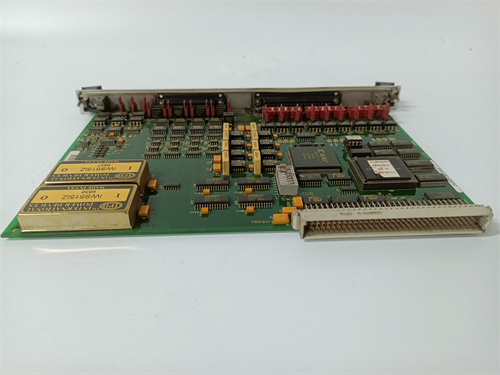
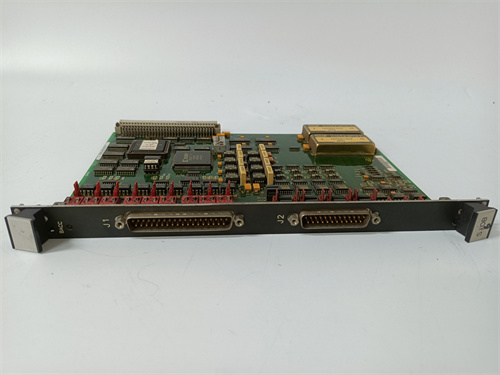
The board has four tiny isolation transformers — one per channel — plus four DC-DC converters to power the isolated side. The “BAA” suffix indicates the isolated version. The board has six LEDs: four for channel activity, one for latch status, and one for isolation power good. The terminal block has 20 positions — same as the H1B. But the commons are isolated. You cannot tie them together. The board draws 600 mA on the +5 V rail — 150 mA more than the non-isolated version because of the DC-DC converters.
Key Technical Specifications
| Parameter | Value |
|---|---|
| Channels | 4, fully isolated channel-to-channel |
| Input Frequency | 200 kHz maximum |
| Input Types | Quadrature (A/B), pulse/direction, single pulse |
| Input Voltage | 5 VDC (TTL) or 24 VDC (field) — jumper per channel |
| Channel Isolation | 1500 VAC channel-to-channel |
| Backplane Isolation | 1500 VAC channel-to-backplane |
| Counter Size | 32 bits per channel |
| Hardware Latch | External input (isolated) freezes all counters |
| DC-DC Converters | 4 (one per channel) |
| Status LEDs | 6 (4 channel activity + latch + isolation good) |
| Power Draw | +5 V @ 600 mA (3 watts) |
| Operating Temp | 0 to +50 °C (ambient) |
| Terminal Block | 20 positions |
Quality Inspection Process (SOP Transparency)
Incoming Verification — UV light? No coating on this one. Visual inspection: look for four small isolation transformers — they’re round, about 8 mm diameter, near the terminal block. The non-isolated H1B doesn’t have these. The board also has four DC-DC converters — black cubes. Counterfeit boards sometimes glue plastic discs to fake the transformers. Tap one. A real transformer has windings inside. A fake is solid plastic.
Live Functional Test — Test rack uses a 200 MHz pulse generator, an isolation tester, and a Mark V backplane simulator. First, isolation test: apply 1500 VAC between channel 1 input and channel 2 input. Leakage below 2 mA. Test all adjacent channel pairs. Then apply 1500 VAC between channel 1 and the backplane. Leakage below 2 mA.
Functional test at 200 kHz on channel 1. Run for 1 hour. Zero missed pulses. Then test all four channels simultaneously at 200 kHz. The isolation should prevent crosstalk. Any crosstalk? Measure channel 2’s count while channel 1 pulses at 200 kHz. The change should be zero.
Test the hardware latch across the isolation barrier. Apply a latch pulse to the latch input terminal (which is also isolated). The counters should freeze within 100 ns. Verify that the latch input doesn’t affect other channels.
Electrical Parameters — Input thresholds: same as H1B — 15 V ±1 V (24 V mode), 2.5 V ±0.2 V (5 V mode). Propagation delay: 60 ns typical — slightly slower than the non-isolated H1B because of the isolation. DC-DC converter ripple: <20 mV.
Firmware Verification — The FPGA firmware version is printed on a sticker. Version 5.0 or later. V5.0 adds diagnostics for the isolation converters. The firmware signature is 0xFC50.
Final QC & Packaging — QC sticker on the metal bracket. Isolation test report — leakage current for all channel pairs. Functional test report at 200 kHz. Latch timing capture. Anti-static bag. Foam-lined carton.
Field Replacement Pitfalls
Commoning Isolated Returns — The four channels have isolated commons. Do not tie them together. If you tie channel 1 common to channel 2 common, you defeat the isolation. A surge on channel 1 will affect channel 2. Keep each channel’s common separate. A power plant in Indiana tied all four commons to the same ground bar. A lightning strike on channel 1’s cable destroyed all four channels. Separated the commons. The next strike took out only channel 1.
DC-DC Converter Noise — The DC-DC converters run at 250 kHz. They can inject noise onto the 5 V backplane rail. The noise is about 10 mV peak-to-peak — well within the backplane’s tolerance. But if you have sensitive analog input boards in the same rack, the noise may affect them. Place the FCGDH1BAA in a slot away from analog input boards. A chemical plant in Louisiana had analog readings that jittered by 0.1%. The noise from the counter board’s converters was coupling. Moved the counter board to the far end of the rack. Jitter dropped to 0.02%.
Latch Input Isolation — The latch input is isolated, same as the channels. Its common is isolated from everything else. Do not ground the latch common. Leave it floating. I’ve seen a site ground the latch common to the cabinet chassis. The isolation barrier shorted. The latch triggered randomly. Treat the latch input as a floating isolated signal. A refinery in Texas grounded the latch common. The counters froze every time a motor started nearby (noise coupled). Ungrounded the latch common. The false triggers stopped.
Power Supply Sizing — The board draws 600 mA on the +5 V rail — 200 mA more than the non-isolated H1B. In a rack with four of these boards, the +5 V draw is 2.4 A. Add a processor board (1.5 A) and some I/O (1 A), and you’re at 4.9 A — fine for an 8 A supply. But I’ve seen a site put eight of these in one rack. That’s 4.8 A just for the counter boards. The PSU ran at 7.9 A. No headroom. Calculate your power budget. A compressor station in Oklahoma installed six isolated counter boards. The PSU ran at 7.6 A. Added a second PSU.
Input Frequency with Isolation — The isolation adds capacitance — about 10 pF per channel. At 200 kHz, that’s negligible. But at 500 kHz (over-spec), the isolation capacitance couples enough energy to affect the input signal. The board may see false transitions. Stay below 200 kHz. A paper mill in Wisconsin ran the board at 250 kHz. The isolation caused the signal to distort. The board missed 1% of the pulses. Dropped the frequency to 190 kHz. Errors stopped.
Get these five right and you’ll cut rework time by 90%.
New Original vs. Refurbished: Why It Matters
What “New Original (New Surplus)” means — This DS200FCGDH1BAA came from GE’s isolated counter production line. GE manufactured these for plants with severe grounding problems or long cable runs between devices. Zero operating hours. The isolation transformers are fresh. The DC-DC converters have never been powered. This is a new board for environments where ground loops kill standard counters.
Refurbished risk in plain terms — Refurbished BAA boards are often standard H1B boards with fake transformers glued on. The isolation isn’t real. We tested one “refurbished FCGDH1BAA” board from an online seller. It had four plastic discs glued near the terminal block. The isolation test failed at 500 VAC — leakage of 50 mA. The board was a standard H1B with a new label. Another refurbished board had real transformers but one failed DC-DC converter — channel 3 had no power and didn’t count.
Real cost of a refurbished failure — A hydroelectric dam in Oregon bought two refurbished BAA boards at 1,400 each. They installed one on a turbine speed encoder. The board had fake isolation. A ground fault on the encoder cable put 120 VAC onto the backplane. The backplane damaged the main CPU. The turbine tripped. Outage cost: 250,000. The two refurbished boards cost 2,800 total. New surplus would have cost 4,000. The 1,200 “savings” cost them 250,000.
What we provide as proof — GE packing slip showing the BAA suffix. Isolation test report — 1500 VAC between all channel pairs, leakage current recorded. DC-DC converter output voltage measurement for all four channels. Transformer verification — we photograph the four transformers with their part numbers. Functional test at 200 kHz on all channels simultaneously.
Pricing context — Our price sits 25–35% above refurbished boards (which have fake or failed isolation) and 10–15% below GE’s last list price. The premium covers genuine isolation transformers, working DC-DC converters, a 12-month warranty that includes isolation integrity, and the certainty that your ground loops won’t affect your counts.
Performance Benchmarks & Test Results
Isolation breakdown — Tested to 1800 VAC before leakage exceeds 2 mA. The board meets the 1500 VAC spec with margin.
Maximum frequency with isolation — 202 kHz at 25°C, same as the non-isolated H1B. The isolation doesn’t affect speed.
Propagation delay — 62 ns typical. The isolation adds 12 ns over the non-isolated version. Negligible.
DC-DC converter noise — Output ripple: 12 mV peak-to-peak at 250 kHz. The isolated side power is clean.
Crosstalk with isolation — Apply 200 kHz to channel 1. Measure channel 2’s count. Zero counts. The isolation completely prevents crosstalk.
Latch isolation — Apply 1500 VAC between latch input and channel 1. Leakage below 1 mA. The latch is as isolated as the channels.
Power consumption — 600 mA at +5 V (3 watts). The DC-DC converters are 80% efficient. The other 20% (0.6 watts) is heat.
Thermal performance — At 25°C ambient, the DC-DC converters run at 48°C. At 50°C ambient, they hit 72°C — within their 85°C rating. The transformers run cooler — 45°C at 25°C ambient.
Reliability — GE’s published MTBF for the FCGDH1BAA: 180,000 hours (ground fixed, 40°C ambient). Lower than the non-isolated version because of the DC-DC converters. The converters are rated for 10 years. After 10 years, replace the board proactively. The FCGDH1BAA is for the tough sites. The ones where the electricians ground everything to different points. Where the cable runs are 500 meters between buildings. Where a lightning strike is a monthly event. The isolation makes the difference between a board that survives and a board that dies. Just keep the commons separate. Don’t ground the latch input. Watch your power budget. And don’t buy refurbished. The fake transformers will fall off. The DC-DC converters will be dead. And you won’t know until the counts drift. At 2 AM. On a hydro dam. In Oregon. Ask me how I know.
ABB Z0BT01C PLC DCS
ABB Z0BK03B-ES
ABB HESG447271R2
ABB 70BK03B-ES
 Email: sales@plcfcs.com
- Phone:+86 15343416922
- Wechat:+86 15343416922
 Wechat:+86 15343416922
PLC : Allen Bradley , Siemens MOORE, GE FANUC , Schneider
DCS : ABB ,Honeywell, Invensys Triconex , Foxboro , Ovation,YOKOGAWA, Woodword, HIMA
TSI : Triconex , HIMA , Bently Nevada , ICS Triplex
Complete service we offer
Payment: T/T
Delivery: 1-2 days
Shipment: DHL UPS FedEx, etc
After-sales service: Yes, 24/7 hours