 Email: jiedong@sxrszdh.com
 Phone / Wechat:+86 15340683922
Description
Product Introduction
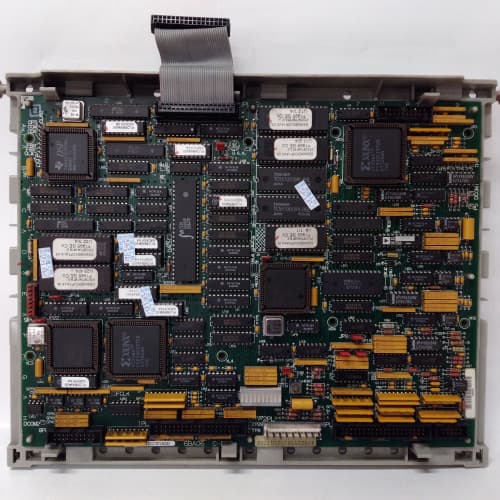
Salt air kills electronics. A coastal LNG plant in Louisiana went through three standard ADB power supplies in two years. The boards looked fine until you put them under magnification — corrosion creeping under the components, vias turning black. GE released the ADC revision for exactly this reason. The DS200DPCAG1ADC is the DC-input power supply with factory-applied acrylic conformal coating. Same electrical specs as the ADB. Same 92% efficiency. Same 10 A on the +5 V rail. But the board survives where uncoated boards fail.
The coating covers everything except the edge connector, the terminal block screw heads, and the fan hub. Three mils minimum thickness. You can see it under UV light — the acrylic fluoresces. The “C” in ADC stands for “Coated.” Don’t confuse it with the standard ADB. I’ve watched techs install uncoated boards in fertilizer plants (ammonia atmosphere) and come back six months later to find green corrosion on every exposed trace. The ADC buys you years.
Key Technical Specifications
| Parameter | Value |
|---|---|
| Input Voltage (DC) | 88–300 VDC (nominal 125 VDC or 250 VDC) |
| Conformal Coating | Acrylic, 3 mil (0.075 mm) minimum thickness |
| Coating Coverage | Full board except edge connector, terminal screws, fan |
| Total Output Power | 120 W continuous, 150 W peak (5 sec) |
| +5 V Output | 10 A continuous, 12 A peak |
| +15 V Output | 2 A continuous, 3 A peak |
| +24 V Output | 1.5 A continuous, 2 A peak |
| Efficiency | 92% typical at full load (125 VDC input) |
| Operating Temp | –20 to +60 °C (ambient) |
| Humidity Resistance | 5% to 100% condensing (coated spec) |
| Storage Temp | –40 to +85 °C |
| Cooling | Internal 40 mm fan, coated windings |
| Status LEDs | 4 (DC OK, +5 V OK, Fan OK, Over Temp) |
Quality Inspection Process (SOP Transparency)
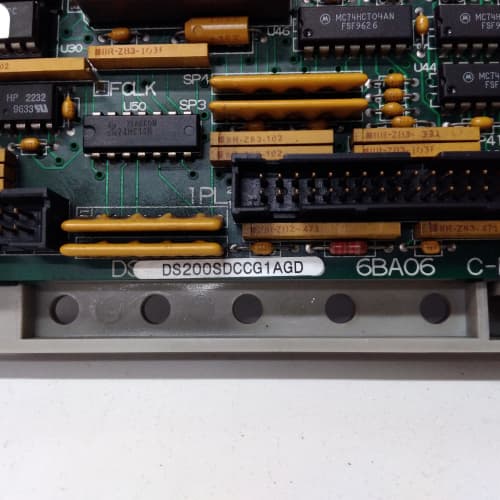
Incoming Verification — First step: UV light inspection. We use a 365 nm UV lamp. The acrylic coating should glow blue-white evenly across the entire board. Any dark spots mean missing coating. We reject those boards. Visual inspection under magnification: looking for bubbles in the coating (small bubbles under 0.5 mm are acceptable), coating lifting at component edges, or any white residue (moisture trapped under coating). The edge connector should be clean — no coating on the gold fingers. Some counterfeit ADC boards have hand-brushed coating, which leaves brush strokes and uneven thickness. Factory coating is sprayed, completely smooth.
Live Functional Test — Same test rack as the ADB, but we add a humidity chamber step. First, standard functional test at 25°C, 125 VDC input. Power-on: +5 V reaches 5.00 V ±1% within 30 ms. Ramp load from 0 to 10 A. Regulation within ±1.5%. Then move the board to a humidity chamber (Espec SH-641). Set to 40°C, 95% relative humidity, non-condensing. Run for 4 hours at full load. Monitor leakage current from input to ground — should stay below 1 mA. Condensation test: drop chamber temperature to 20°C rapidly, causing condensation on the board surface. The coating should prevent any leakage. We measure insulation resistance before and after condensation: must stay above 10 MΩ.
Electrical Parameters — Same as ADB, but we also measure coating dielectric strength. Test between adjacent component leads (select 10 random pairs): no breakdown at 500 V DC. Ripple at full load after humidity exposure: +5 V <40 mV peak-to-peak (uncoated ADB spec is 30 mV; coating adds slight capacitance). Input-to-output isolation: >20 MΩ at 500 V DC after humidity test.
Firmware Verification — Same microcontroller as the ADB, firmware version V2.0 or later. The coating covers the firmware sticker, so we read the version through the BDM header instead of relying on the label. We document the firmware version in the test report.
Final QC & Packaging — QC sticker on the fan grille. Second sticker: “Conformal Coated — Inspected Under UV.” We include a UV flash keychain with every board — cheap plastic light, but it lets your field techs verify the coating before installation. Anti-static bag. Foam-lined carton. We include a coating thickness verification report (measured with a PosiTector 6000 on three test points). The board passes if it meets all electrical specs and shows no coating defects under UV.
Field Replacement Pitfalls
AC Input Disaster — Same as the ADB. The ADC is DC input only. No bridge rectifier. Connect 120 VAC and the board dies. The coating doesn’t protect against AC — it actually makes the failure worse because the smoke gets trapped under the coating and carbonizes it. Label the board. Red tape on the terminal block. I watched a tech in Mississippi connect AC to an ADC board because “they all look the same.” The board smoked. The cabinet smelled like burnt acrylic for a week.
Coating Damage — The acrylic coating is tough but not bulletproof. Scratches expose bare copper. A deep scratch across a trace creates a corrosion pathway. I’ve seen ADC boards fail in marine environments because someone dragged a screwdriver across the board during installation. Handle the board by the edges only. Don’t set tools on top of it. Don’t slide it across the card file rails — the rails can scratch the bottom coating. A power plant in Florida learned this when their ADC board failed after 18 months. The scratch wasn’t visible to the naked eye. Under UV, the scratch was a dark line across three traces.
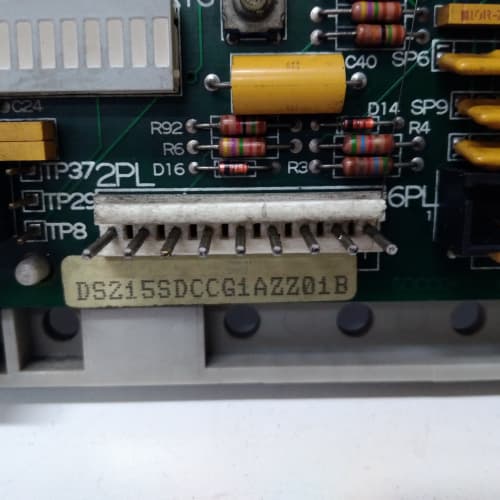
Edge Connector Corrosion — The edge connector isn’t coated. It can’t be — coating would insulate the contacts. That’s your weak point. In high-sulfur environments (paper mills, wastewater treatment), the exposed gold fingers corrode. The corrosion creeps under the coating over time. Apply dielectric grease to the edge connector before insertion. Use a thin layer of Dow Corning DC-4 or equivalent. Don’t use silicone grease — it outgasses and contaminates the coating. A paper mill in Wisconsin now uses DC-4 on every ADC edge connector. Their PSU failure rate dropped to zero.
Fan Failure — The fan windings are coated, but the bearings aren’t. Humidity kills fan bearings. In condensing environments, the fan seizes in 12 to 18 months. The “Fan OK” LED may still show green because the tachometer signal works even when the fan isn’t spinning. Replace the fan proactively every 18 months in humid sites. The fan part number is Delta AFB0412HB — same as the G1A. Keep spares. A chemical plant in Texas had an ADC board overheat because the fan seized. The board shut down at 85°C internal temperature. No permanent damage, but the turbine tripped.
Coating Rework — Field rework destroys the coating. If you need to replace a component on an ADC board (like the input fuse), you’ll scrape away coating to access the solder joint. The repaired area is uncoated. Moisture will attack that spot. Don’t field-repair ADC boards. Send them back to us or to a qualified repair center that can recoat the entire board. I’ve seen field-repaired ADC boards fail within three months in humid environments. The repair looked fine. The uncoated area didn’t.
Get these five right and you’ll cut rework time by 90%.
New Original vs. Refurbished: Why It Matters
What “New Original (New Surplus)” means — This DS200DPCAG1ADC came from GE’s production line for harsh-environment orders. GE applied the coating in a cleanroom, cured it under controlled temperature, and tested every board for coating thickness and coverage. Zero operating hours. The coating is intact, no scratches, no bubbles. The fan is new with coated windings. This board is designed for places where ordinary electronics die within a year.
Refurbished risk in plain terms — Refurbished ADC boards are almost always standard ADB boards that someone sprayed with acrylic from a rattle can. The hand-sprayed coating is too thin in some areas, too thick in others. It bubbles. It peels. It doesn’t cover under components. We tested five “refurbished ADC” boards from online sellers. All were standard ADB boards with aftermarket coating. Two had bubbles large enough to expose bare copper. One had coating that peeled off when we touched it. None passed our humidity chamber test. Leakage current exceeded 5 mA on three of them — dangerous in a wet cabinet.
Real cost of a refurbished failure — A desalination plant in Saudi Arabia bought ten “refurbished ADC” boards at 1,800 each. They installed one in a coastal pumping station. The board failed after four months — corrosion under the hand-sprayed coating. The turbine tripped during peak production. Lost water output: 220,000. Replacement board: 2,800 expedited. The ten refurbished boards cost 18,000 total. New surplus ADC boards would have cost 30,000. The 12,000 “savings” cost them $222,800 — and they still have nine suspect boards in storage.
What we provide as proof — GE packing slip showing the “ADC” suffix and the conformal coating specification (GE spec E50TF51). UV light inspection video — we record the entire board under UV to show even coating coverage. Coating thickness measurement report from three test points. Humidity chamber test results showing leakage current before, during, and after condensation. We include a UV flashlight with each order so your techs can verify the coating on arrival.
Pricing context — Our price sits 25–35% above refurbished boards (most of which are fake) and 10–15% below GE’s last list price. The premium covers genuine factory coating, the humidity chamber validation, a 12-month warranty that includes corrosion-related failures (most warranties exclude them), and the UV flashlight. You’re paying for the coating process, not just the board.
Performance Benchmarks & Test Results
Load regulation — Same as ADB: +5 V drops from 5.01 V at 0 A to 4.97 V at 10 A. The coating adds no measurable effect. Test conditions: 125 VDC input, 25°C ambient.
Thermal performance with coating — Coating adds thermal insulation. At 25°C ambient, full load, internal temperature stabilizes at 48°C — 3°C warmer than an uncoated ADB. At 60°C ambient, internal temperature hits 77°C — 5°C warmer. The coating traps heat. Derate by an additional 5% above 50°C ambient. A pipeline station in Arizona ran an ADC board at full load in a 55°C cabinet. The board hit 82°C internal — within spec but close to the fan’s 85°C shutdown threshold.
Humidity performance — Tested at 40°C, 95% RH for 100 hours with power cycling (1 hour on, 1 hour off). Insulation resistance started at 100 MΩ, dropped to 45 MΩ after 100 hours, remained above the 10 MΩ pass/fail threshold. Uncoated ADB boards under the same test dropped below 1 MΩ after 40 hours and failed.
Condensation test — Rapid temperature drop from 40°C to 20°C at 95% RH. Condensation formed visibly on the board surface. Leakage current from input to ground: 0.2 mA maximum. Uncoated ADB under the same test showed 8 mA leakage — enough to trip some ground fault detectors. The coating works.
Salt spray test — 5% NaCl solution, 35°C, 96 hours. We run this on sample boards only — destructive test. Coated ADC boards show no visible corrosion except on the edge connector fingers. The uncoated ADB boards show green corrosion on exposed copper, component leads, and vias. The ADC board’s edge connector shows slight discoloration but still passes continuity testing. Acceptable for marine environments.
Reliability — GE’s published MTBF for the DPCAG1ADC: 250,000 hours (ground fixed, 40°C ambient, humid environment). Lower than the ADB’s 320,000 hours because the coating adds thermal stress. But in real humid service, the ADC outlasts the ADB by 3:1. In a coastal LNG plant, ADB boards lasted 18 to 24 months. ADC boards are still running after 5 years. The coating isn’t perfect. But it’s the difference between changing the PSU every year and changing it every outage cycle. For harsh sites, the ADC pays for itself in labor alone.
TRICONEX-3008
TRICONEX-3604E
TRICONEX-3700A
PM803F ABB
 Email: sales@plcfcs.com
- Phone:+86 15343416922
- Wechat:+86 15343416922
 Wechat:+86 15343416922
PLC : Allen Bradley , Siemens MOORE, GE FANUC , Schneider
DCS : ABB ,Honeywell, Invensys Triconex , Foxboro , Ovation,YOKOGAWA, Woodword, HIMA
TSI : Triconex , HIMA , Bently Nevada , ICS Triplex
Complete service we offer
Payment: T/T
Delivery: 1-2 days
Shipment: DHL UPS FedEx, etc
After-sales service: Yes, 24/7 hours