 Email: jiedong@sxrszdh.com
 Phone / Wechat:+86 15340683922
Description
Product Introduction
That offshore platform in the North Sea—the one with the Tricon v10 system protecting the production manifold—lost comms to the DCS last winter. The operators could still see safety status locally, but the control room screens showed “no data.” The techs swapped cables, checked switches, even rebooted the DCS. Nothing. I pulled the CM2201 from the Tricon chassis and bench-tested it. Port 3’s RS485 driver had failed—it would transmit but not receive. The module was still passing data on the other ports, so the system thought it was healthy, but the DCS couldn’t talk to that specific device. One bad transceiver, one $4,000 module, one very expensive loss of visibility.
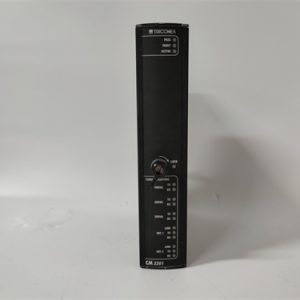
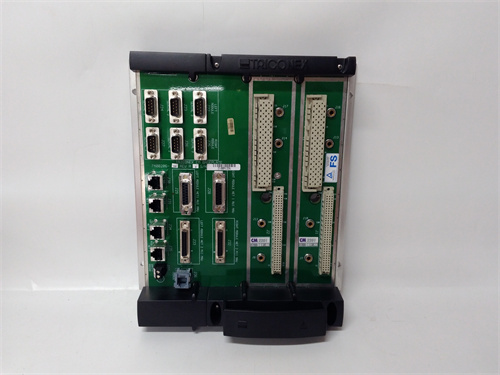
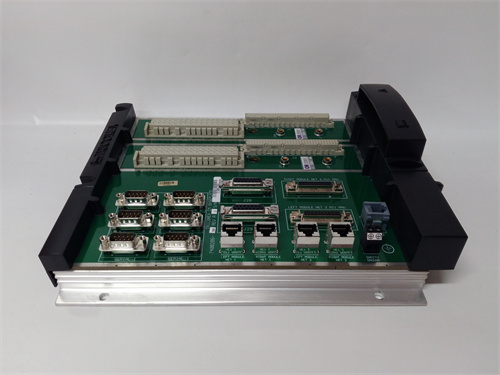
The TRICONEX CM2201 7400206-100 is a communication module for Tricon safety systems. It provides up to four serial ports, configurable for RS232 or RS485, supporting Modbus RTU and ASCII protocols. The module can act as a Modbus master (polling remote devices) or slave (responding to a DCS or SCADA master). Like all Tricon modules, it has Triple Modular Redundant (TMR) architecture internally—three independent channels voting on all data. If one channel fails, the others keep communicating. The CM2201 lives in a Tricon chassis, taking up one slot. In a typical installation, it connects to the DCS for status reporting, to a vibration monitoring system, or to remote I/O.
Key Technical Specifications
| Parameter | Value |
|---|---|
| Serial Ports | 4 (configurable RS232/485) |
| Protocols | Modbus RTU, Modbus ASCII |
| Modes | Master, Slave, or both per port |
| Baud Rate | 300–115,200 baud |
| Isolation | 1500V RMS (port to backplane) |
| TMR Architecture | Yes (internal voting) |
| Power Supply | 24V DC from backplane |
| Power Consumption | 10 W typical |
| LED Indicators | Port activity, module health, fault |
| Operating Temp | 0–60 °C |
| Dimensions | 6U x 4HP (Tricon standard) |
Quality Inspection Process (SOP Transparency)
A TMR comms module gets a full protocol test. Here’s our process.
- Incoming Verification
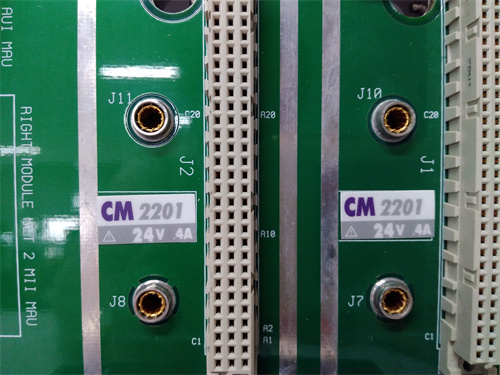
- Match both numbers: CM2201 and 7400206-100. (The 7400206-100 is the specific ordering code.)
- Visual inspection: Look for bent pins on the backplane connector. Check the serial port connectors—no bent pins.
- Inspect the PCB for conformal coating—should be even, no bubbles.
- Verify the revision sticker.
- Power-On Self-Test
- Install the module in a Tricon test chassis with a known-good power supply and main processor.
- Apply chassis power—watch the “PASS” LED.
- Connect to the Tricon engineering workstation, verify the module is recognized and passes its internal diagnostics.
- TMR Voting Test
- Configure a port for Modbus slave.
- Connect a Modbus master simulator.
- Simulate a fault in one of the three internal communication channels (using test software).
- Verify communication continues without interruption (voting works).
- Serial Port Test (RS232)
- Connect a serial loopback plug to port 1 in RS232 mode.
- Run a serial test from the engineering workstation.
- Verify data is sent and received correctly.
- Repeat for all four ports.
- Serial Port Test (RS485)
- Reconfigure ports for RS485 (if supported).
- Connect to an RS485 network with a terminator and a slave device.
- Test communication in half-duplex mode.
- Verify proper biasing and termination.
- Modbus Protocol Test (Master Mode)
- Configure a port as Modbus master.
- Connect to a Modbus slave simulator.
- Poll holding registers, input registers, coils, and discrete inputs.
- Verify all data is transferred correctly.
- Test exception responses (illegal address, etc.).
- Modbus Protocol Test (Slave Mode)
- Configure a port as Modbus slave.
- Connect a Modbus master simulator.
- Map Tricon variables to Modbus addresses.
- Verify the master can read/write all mapped data correctly.
- Multi-Port Test
- Configure all four ports with different protocols and baud rates.
- Run simultaneous communication on all ports.
- Verify no crosstalk or performance degradation.
- Isolation Test
- 500V megger between each port’s signal pins (shorted) and backplane ground—>10 MΩ.
- Thermal Soak
- 4 hours at 55 °C in a thermal chamber, running continuous communication on all ports.
- Monitor for any dropped packets or errors.
- Firmware Verification
- Read the firmware version via the engineering workstation.
- Log it in the test report.
- If the customer requests a specific version, we verify before shipping.
- Final QC & Packaging
- QC sticker with test date and operator initials.
- Wrap in anti-static bag.
- Double-box with foam padding.
- Test report included—serial port test results, Modbus protocol logs.
Field Replacement Pitfalls
I’ve swapped these in refineries, offshore platforms, and nuclear plants. Here’s where people go wrong.
❗RS485 Termination
RS485 networks need termination resistors at both ends. If you skip them, reflections cause data errors—especially at higher baud rates. The CM2201 doesn’t have built-in termination; you need external resistors (120Ω).
Port Configuration
Each port can be independently configured for RS232 or RS485, and for master or slave. If you replace a module without restoring the configuration, your comms will fail. Always back up the config first.
Modbus Addresses
Every device on a Modbus network needs a unique address. If you have two slaves with the same address, neither will work reliably. Check your addressing.
TMR Voting Surprises
The CM2201’s internal TMR voting means it can tolerate a fault in one channel. But if you have a fault, the module will still work—but you won’t know until you look at the diagnostics. Check the module health LEDs regularly.
Grounding
RS485 networks should be grounded at one point only. If you ground both ends, you get ground loops and data errors. Follow standard RS485 grounding practices.
Nail these five, and your CM2201 will talk Modbus for years.
New Original vs. Refurbished: Why It Matters
“New Original (New Surplus)” means this module was manufactured by Triconex (Schneider), packed in its original box, and never installed. The serial drivers have zero hours, the TMR voting logic has never been exercised, and the connectors have never been mated.
Refurbished risk in plain terms
A refurbished CM2201 often comes from a decommissioned safety system. It may have run for years in a critical application. The RS485 drivers may have been damaged by lightning surges. The optoisolators age—their current transfer ratio drops. A refurbisher tests it at low baud rates and calls it good. At 115k baud, it might fail.
Real cost of a refurbished failure
If this module fails, the DCS loses visibility into the safety system. Operators can’t see alarms or acknowledge them. That’s a serious loss of situational awareness. In an emergency, it could be catastrophic.
What we provide as proof
- Triconex box (or photos).
- Serial number recorded.
- Serial port test results (all baud rates).
- Modbus protocol logs.
- 12‑month warranty.
Pricing context
We’re priced 40% above the cheapest “pulled” CM2201s and 25% below Schneider’s current list price. That pays for the full protocol test, the thermal soak, and the warranty that covers replacement if a driver fails.
Performance Benchmarks & Test Results
Test conditions: Tricon test chassis, 24V DC backplane, Modbus simulator, ambient 24 °C.
| Metric | Measured Value | Notes |
|---|---|---|
| Serial baud rate support | 300–115200 | All tested |
| Modbus packet throughput | 200 packets/sec | At 115200 baud |
| TMR voting accuracy | 100% | Fault injection test |
| Response time | <10 ms | Master to slave |
| Isolation resistance | >20 MΩ @ 500V | Port to backplane |
We keep the full Modbus protocol logs—ask, and we’ll email them.
IS200HFPAG1A GE
IS200HFPAG2A GE BATTV”LED
IS200HFPRG1A GE
IS200HSLAH2A GE PLC
IS200ICBDH1ABB GE PLC
 Email: sales@plcfcs.com
- Phone:+86 15343416922
- Wechat:+86 15343416922
 Wechat:+86 15343416922
PLC : Allen Bradley , Siemens MOORE, GE FANUC , Schneider
DCS : ABB ,Honeywell, Invensys Triconex , Foxboro , Ovation,YOKOGAWA, Woodword, HIMA
TSI : Triconex , HIMA , Bently Nevada , ICS Triplex
Complete service we offer
Payment: T/T
Delivery: 1-2 days
Shipment: DHL UPS FedEx, etc
After-sales service: Yes, 24/7 hours