 Email: jiedong@sxrszdh.com
 Phone / Wechat:+86 15340683922
Description
Product Overview
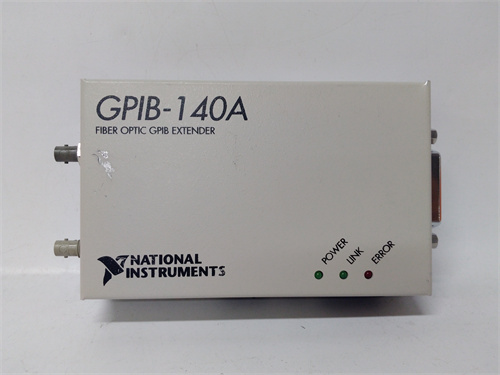
The NI GPIB-140A is a specialized interface module from National Instruments designed to extend and translate the GPIB (General Purpose Interface Bus), also known as IEEE-488, protocol. This module is not a traditional PLC component but a crucial communication bridge in test, measurement, and automation systems that integrate legacy or specialized instruments. Its primary function is to act as a GPIB extender, allowing the GPIB bus to be transmitted over longer distances (via Ethernet or other media) than the standard cable length limit, or to act as an interface between different control systems. For detailed user manuals, configuration guides, and specifications, please refer to the official product resource: NI GPIB-140A. The NI GPIB-140A solves connectivity challenges in complex rack-and-stack test systems where instruments with GPIB ports need to be controlled from a remote computer or integrated into a larger automated framework.
Product Parameters and Specifications
- Function: GPIB Bus Extender / Interface Module.
- Core Technology: Acts as a GPIB-to-GPIB repeater/extender. It typically has two or more GPIB ports and internal circuitry to buffer and regenerate the GPIB signals, effectively extending the permissible cable length and device count on the bus.
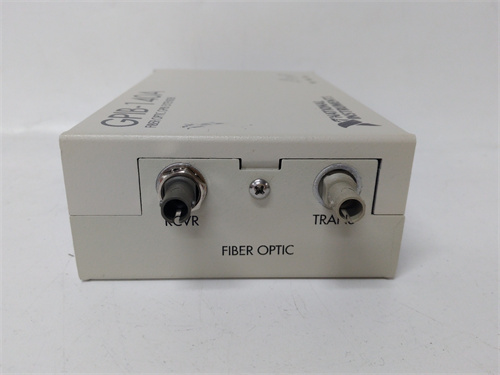
- Extension Method: Specific models may use different methods for the extension link. Common versions might use fiber optic cables for extremely long distances and high noise immunity, or TCP/IP over Ethernet to create a network-based GPIB link.
- Bus Enhancement: Helps overcome standard GPIB limitations, such as the maximum total cable length (typically 20 meters) and the maximum number of devices (typically 15), by segmenting the bus.
- Compatibility: Fully compliant with the IEEE-488.1 and IEEE-488.2 standards, ensuring compatibility with a vast array of legacy test equipment from manufacturers like Hewlett-Packard (HP/Agilent/Keysight), Tektronix, Keithley, and others.
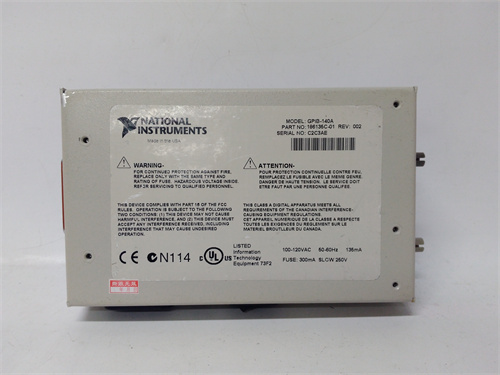
- Power Supply: Requires an external DC power adapter.
- Form Factor: A standalone desktop or rack-mount unit with multiple GPIB (IEEE-488) connectors on the front/back.
Advantages and Key Features
The primary advantage of the NI GPIB-140A is its ability to modernize and extend the reach of legacy GPIB-based systems without replacing expensive instruments. It provides electrical isolation and noise immunity, especially in fiber-optic versions, protecting sensitive measurement equipment from ground loops and electrical interference in industrial environments. The module increases system design flexibility by allowing instruments to be physically located far from the controlling computer, which is essential in large test facilities or distributed systems. It simplifies system integration by acting as a reliable bridge, ensuring stable communication where direct cabling is impractical. Using a genuine NI GPIB-140A guarantees compatibility with National Instruments’ NI-488.2 driver software, ensuring reliable communication and support within the NI ecosystem.
Application Cases in Industry
This module is predominantly used in automated test equipment (ATE) and research & development settings. In Aerospace and Defense ATE, it connects racks of legacy GPIB instruments (power supplies, signal generators, spectrum analyzers) to a central control PC in a different part of the facility. Within Semiconductor Manufacturing, it is used in wafer test systems to interface with parametric analyzers and meters. For Automotive Component Testing, the NI GPIB-140A can link vibration controller systems and data acquisition units over longer distances. It is also found in Calibration Laboratories to control standard instruments from a centralized workstation. Any industry that has a significant installed base of high-quality GPIB instruments relies on extenders like the GPIB-140A to integrate them into modern, computer-controlled systems.
Comparison with Competing Products
- vs. Direct GPIB Cabling: Direct cabling is simple but limited by distance and device count. The NI GPIB-140A removes these limitations, which is its sole reason for existence.
- vs. GPIB-to-USB or GPIB-to-PCI Controllers: These adapters (e.g., NI GPIB-USB-HS) connect a computer to a GPIB bus locally. The GPIB-140A is used in addition to such a controller to extend that bus. They are complementary, not direct competitors.
- vs. Other Brand GPIB Extenders (e.g., from ICS Electronics, IOtech/Measurement Computing): Competing products offer similar functionality. The NI GPIB-140A differentiates itself through its strong integration with the NI software stack (LabVIEW, NI-MAX, NI-488.2), often perceived higher quality/reliability, and global support network. Competition is based on specific features like supported distance, link medium (fiber vs. Ethernet), and cost.
Selection Suggestions and Precautions
- Selection Advice:
- Identify the Extension Need: Determine if you need to overcome distance limitations, increase the device count, or achieve noise isolation. This will dictate whether you need a basic repeater, a fiber-optic extender, or an Ethernet-based model.
- Verify the Specific Model Variant: The GPIB-140A may have sub-models (e.g., GPIB-140A/100 for fiber). Ensure you select the variant that matches your intended extension medium and required range.
- System Topology Planning: Plan your GPIB bus segments carefully. The extender divides the bus into separate electrical segments; ensure each segment’s cable length and device count remain within IEEE-488 specifications.
- Driver and Software: Ensure your control PC has the appropriate NI-488.2 driver installed. The extender itself is typically transparent to the software, but the overall system stability depends on correct drivers.
- Important Precautions:
- Power Sequencing: It is often recommended to power on the NI GPIB-140A extender before turning on the connected GPIB instruments and controller to ensure proper bus initialization.
- Cable Quality: Even with an extender, use high-quality, shielded IEEE-488 cables. Poor cables can cause communication errors even over short segments.
- Termination: Ensure that each GPIB bus segment is properly terminated if required. Some extenders provide internal termination; check the manual.
- Address Conflicts: After segmenting the bus, ensure that no two instruments on the entire extended system have the same GPIB primary address (0-30).
505-7016 SIEMENS
505-6308 SIEMENS PLC
505-6851A SIEMENS PLC
505-5518 SIEMENS PLC
6SE7090-0XX84-0AB0 SIEMENS PLC
6SE7090-0XX84-0KA0 SIEMENS
 Email: sales@plcfcs.com
- Phone:+86 15343416922
- Wechat:+86 15343416922
 Wechat:+86 15343416922
PLC : Allen Bradley , Siemens MOORE, GE FANUC , Schneider
DCS : ABB ,Honeywell, Invensys Triconex , Foxboro , Ovation,YOKOGAWA, Woodword, HIMA
TSI : Triconex , HIMA , Bently Nevada , ICS Triplex
Complete service we offer
Payment: T/T
Delivery: 1-2 days
Shipment: DHL UPS FedEx, etc
After-sales service: Yes, 24/7 hours