 Email: jiedong@sxrszdh.com
 Phone / Wechat:+86 15340683922
Description
Product Introduction
That automated test stand outside Detroit—the one running durability cycles on transmission solenoids—had a channel drop out. The techs swapped the CFP-DO-400 with a spare, but the new module wouldn’t turn on the same solenoids. They called me, frustrated. Walked them through it: the old module was configured for sourcing outputs (internal +24V), but the CFP-DO-400 is sinking. It needs the load connected between +24V and the output. Swap the wiring, bingo, solenoids clicking again. The module was fine. The wiring wasn’t.
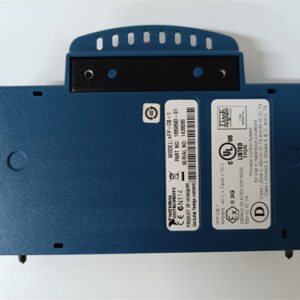
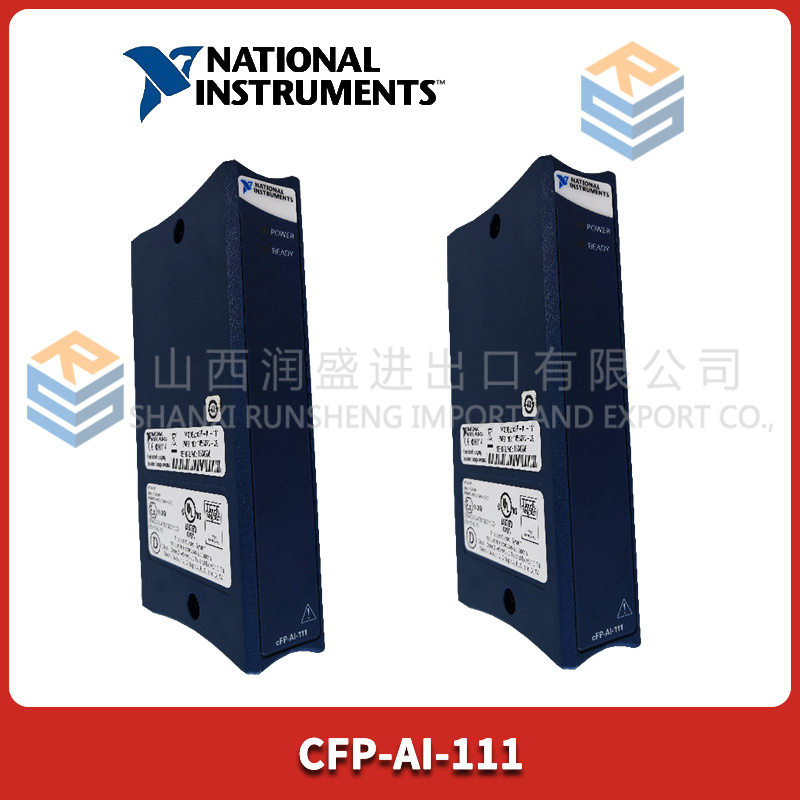
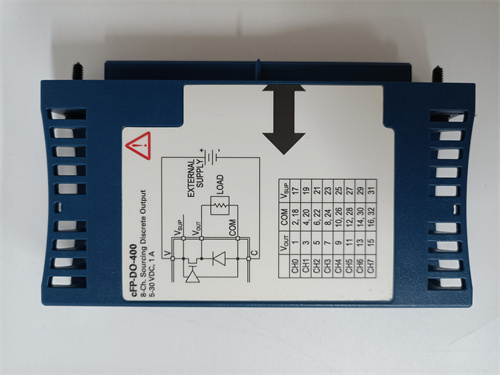
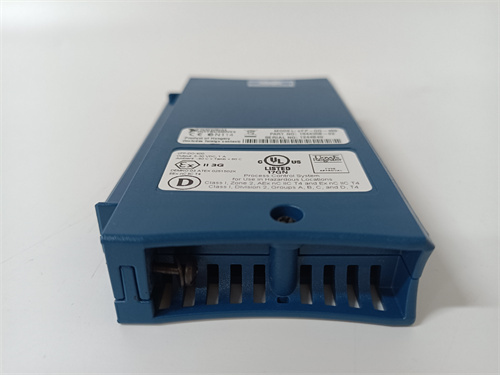
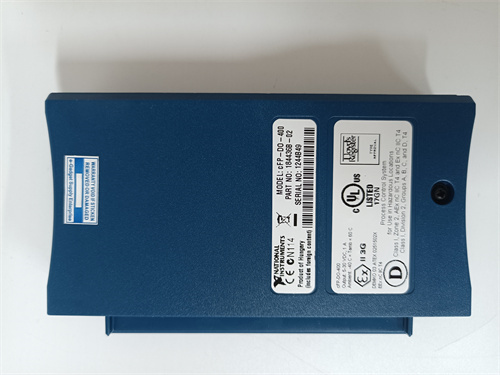
The NI CFP-DO-400 is a 16-channel digital output module from the Compact FieldPoint family. It’s built for industrial environments—metal can, screw terminals, hot-swappable. Each channel is a sinking output: when you turn it on, it connects the output pin to common (0V). That means your load has to be wired between a +24V supply and the output pin. Inside, each channel has an optocoupler and a power transistor, isolated from the backplane by 250V. The module talks to the FieldPoint bus via a simple serial protocol, so the controller (like a cFP-20xx) sees it as 16 bits of output data. No intelligence onboard—just switching. That simplicity makes it reliable. When it fails, it’s almost always external: blown transistor from a short, or a melted terminal from overcurrent.
Key Technical Specifications
| Parameter | Value |
|---|---|
| Output Channels | 16 |
| Output Type | Sinking (open collector) |
| Voltage Range | 10–30V DC |
| Max Current per Channel | 500 mA (resistive load) |
| Max Current per Module | 2 A total |
| On-State Voltage Drop | <0.5V @ 500 mA |
| Off-State Leakage | <10 µA |
| Isolation | 250V RMS (channel-to-backplane) |
| Switching Time | 100 µs (resistive load) |
| Output Protection | Transient suppression (no short-circuit protection) |
| Power Supply | 10–30V DC (field power, separate from backplane) |
| Hot-Swappable | Yes |
| Terminal Type | Screw terminal (removable) |
| Operating Temp | -40 to 70 °C |
| Dimensions | 188 × 88 × 28 mm |
Quality Inspection Process (SOP Transparency)
We treat these modules like the industrial workhorses they are. Here’s our gauntlet.
- Incoming Verification
- Match the model: CFP-DO-400. (There’s a -401 variant with different termination—ours is screw terminal.)
- Visual inspection: Check the metal housing for dents. Inspect the backplane connector pins—should be straight, no corrosion.
- Look at the terminal block: no cracks, screws turn freely.
- Power-On Self-Test
- Insert the module into a cFP-1804 test backplane with a cFP-20xx controller.
- Apply 24V DC field power to the module’s Vsup and COM terminals.
- Watch the READY LED—should light steady within 2 seconds.
- Cycle power three times, watch for any LED flicker.
- Output Functional Test
- Connect a 500 Ω resistor (≈50 mA load) between each output and +24V.
- From LabVIEW or a simple Modbus test script, turn each channel on/off in sequence.
- Verify voltage at the output pin: <0.5V when on, >23.5V when off (with load connected).
- Test all 16 channels individually, then all on simultaneously.
- Overcurrent Test
- Briefly short one output to ground (with software off, then on). The module should survive—no smoke, no blown traces.
- Note: The CFP-DO-400 has no electronic short protection, so we don’t dwell here. We just verify it doesn’t instantly fail.
- Isolation Test
- 500V megger between field terminals (shorted) and backplane ground—must hold >10 MΩ.
- Repeat between each output channel and common—>10 MΩ.
- Thermal Soak
- 4 hours at 60 °C in a thermal chamber, running all outputs at 400 mA (80% load).
- Monitor case temperature with a thermocouple—should stabilize below 85 °C.
- Final QC & Packaging
- QC sticker with test date and operator initials.
- Wrap in anti-static bag (the backplane connector is static-sensitive).
- Double-box with foam—the metal housing can dent if dropped.
- Test report included—channel resistance, isolation values.
Field Replacement Pitfalls
I’ve swapped these in factories, water plants, and even a shipboard monitoring system. Here’s where people go wrong.
❗Sourcing vs. Sinking Confusion
The CFP-DO-400 is sinking. That means the load must be connected between a positive supply and the output. If you wire it with the load between the output and ground (like you would with a sourcing module), it won’t work—output turns on, but no current flows. We’ve seen entire panels rewired because nobody read the manual.
Field Power Polarity
Vsup is positive, COM is common. Swap them, and the module still powers up—but the outputs won’t switch properly. The LEDs might even light. But the transistors need the right polarity to saturate. Always check with a meter before applying power.
No Short Protection
The outputs are not short-protected. If a solenoid wire chafes and shorts to ground, the transistor dies instantly. In high-vibration environments, we recommend adding external fuses (500 mA fast-blow) on each channel. A panel of sixteen fuses is cheaper than replacing the module.
Terminal Block Screws
These are small M2 screws. Over-torque them, and you strip the threads in the plastic. Then the terminal block is junk. Use a small screwdriver, snug is enough.
Hot-Swap Sequence
The module is hot-swappable, but you need to insert it firmly until the latch clicks. If it’s not fully seated, the backplane connector might make intermittent contact—random channel dropouts. Push until you feel the stop.
*Nail these five, and the CFP-DO-400 will outlast the machine it’s controlling.*
New Original vs. Refurbished: Why It Matters
“New Original (New Surplus)” means this module was manufactured by National Instruments, packed in its original box, and never installed. The optocouplers have zero hours, the terminal block screws have never been turned, and the backplane connector has never been mated.
Refurbished risk in plain terms
A refurbished CFP-DO-400 often comes from a decommissioned test stand. It may have switched solenoids for years—the output transistors have wear. Refurbishers test them at low current and call them good. But a transistor that’s been thermally cycled thousands of times has a higher chance of failing shorted. When it fails shorted, the load stays on until somebody pulls the wire.
Real cost of a refurbished failure
If that output controls a cooling water valve that sticks open, you could flood a room. Or if it controls a heater that stays on, you could melt product. The cost of that one incident often exceeds the price of ten new modules.
What we provide as proof
- NI box (or photos).
- Serial number recorded (on the PCB inside—we photograph it).
- Test report with channel resistance and isolation values.
- QC sticker with date.
- 12‑month warranty.
Pricing context
We’re priced 35% above the cheapest “pulled” CFP-DO-400s and 25% below NI’s last list price (long obsolete). That pays for the fresh test, the thermal soak, and the warranty that actually covers replacement if a transistor fails.
Performance Benchmarks & Test Results
*Test conditions: cFP-1804 backplane, 24.0V DC field supply, 500 Ω load (≈48 mA), ambient 24 °C.*
| Metric | Measured Value | Notes |
|---|---|---|
| On-state voltage drop | 0.42V @ 500 mA | Worst channel |
| Off-state leakage | 2 µA | Below spec |
| Turn-on time | 85 µs | 10–90% into resistive load |
| Turn-off time | 72 µs | 90–10% |
| Thermal rise (full load) | 38 °C above ambient | After 4 hours at 400 mA/ch |
| Isolation resistance | >20 MΩ @ 500V | Channel to backplane |
We keep a photo of every channel’s switching waveform—ask, and we’ll email it.
DS2020ERCAG1 GE
DS2020EXPMG2 GE CPU
DS2020EXPSG1 GE PLC
DS2020EXPSG3 GE PLC
DS2020EXTYG2 GE HMI
 Email: sales@plcfcs.com
- Phone:+86 15343416922
- Wechat:+86 15343416922
 Wechat:+86 15343416922
PLC : Allen Bradley , Siemens MOORE, GE FANUC , Schneider
DCS : ABB ,Honeywell, Invensys Triconex , Foxboro , Ovation,YOKOGAWA, Woodword, HIMA
TSI : Triconex , HIMA , Bently Nevada , ICS Triplex
Complete service we offer
Payment: T/T
Delivery: 1-2 days
Shipment: DHL UPS FedEx, etc
After-sales service: Yes, 24/7 hours