 Email: jiedong@sxrszdh.com
 Phone / Wechat:+86 15340683922
Description
Product Description
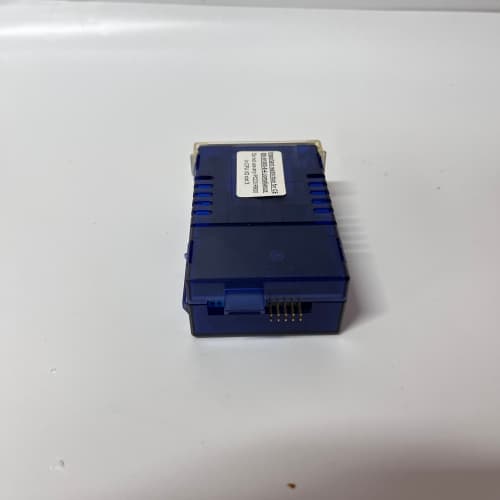
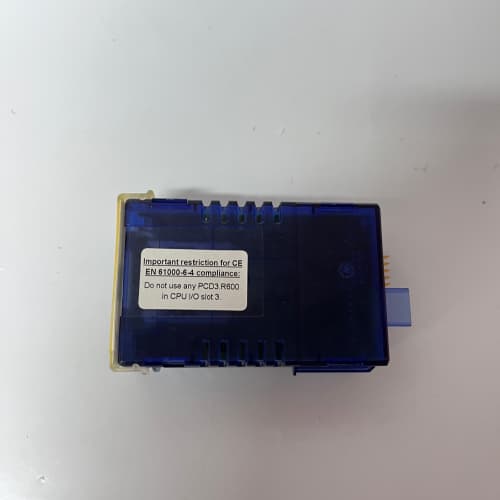
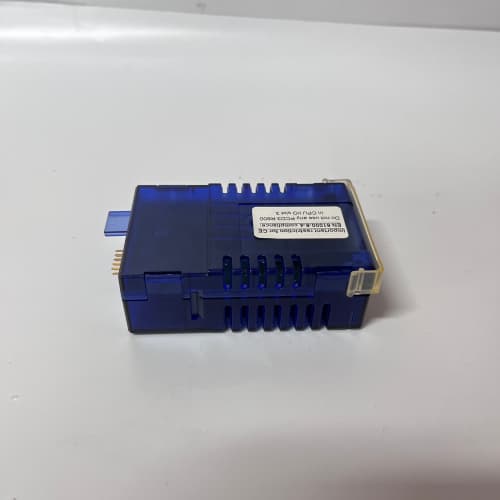
HONEYWELL SAI-1620M CCV1.4 is a specialized Signal Acquisition Interface card from Honeywell, specifically the SAI-1620M model running firmware version CCV1.4. This module is not a traditional PLC or DCS controller, but a critical data acquisition and conditioning unit, often used as a front-end interface within Honeywell’s Scan 3000 or other legacy data acquisition systems. The primary function of the HONEYWELL SAI-1620M CCV1.4 is to provide a high-density, reliable interface for reading and conditioning a variety of analog and digital signals from field sensors—such as thermocouples, RTDs, millivolt signals, and discrete contacts—before transmitting the data to a higher-level system for monitoring, logging, or basic control. It acts as a remote, intelligent marshalling cabinet. For system integrators dealing with large-scale data acquisition, the SAI-1620M is a workhorse component for gathering process data from distributed field locations.
Product Parameters / Technical Specifications
- Manufacturer: Honeywell
- Product Line: Signal Acquisition Interface (SAI) / Scan 3000 System
- Model & Version: SAI-1620M module with Control Code Version 1.4 (CCV1.4) firmware.
- I/O Capacity: High-density module, with “1620” suggesting a capacity of 16 analog and 20 digital channels, or a similar configuration.
- Input Types (Typical for SAI):
- Analog Inputs: Thermocouples (Types J, K, T, E, etc.), RTDs (PT100, PT1000), 0-20mA, 4-20mA, 0-10VDC.
- Digital Inputs: Contact closures, voltage-free contacts, or 24VDC status signals.
- Signal Conditioning: Provides per-channel isolation, filtering, linearization (for T/C and RTD), and cold-junction compensation.
- Communication: Typically interfaces with a host system (e.g., a Honeywell DCS or SCADA server) via a serial communication protocol like Modbus RTU or a proprietary Honeywell bus.
- Configuration: Configured via dedicated software tools or DIP switches to set address, baud rate, and I/O types.
- Power Supply: Requires an external DC power supply (e.g., 24VDC).
Advantages and Key Features
- High-Density Signal Consolidation: The HONEYWELL SAI-1620M dramatically reduces wiring complexity by consolidating a large number of diverse field signals into a single, remotely mountable unit.
- Versatile Input Support: Its ability to handle a wide mix of analog sensor types (T/C, RTD, mA) and digital signals in one module provides exceptional application flexibility.
- Built-in Signal Conditioning: Eliminates the need for external transmitters or signal conditioners for common sensors, reducing cost and points of failure.
- Remote Deployment: Designed to be installed close to the field sensors, minimizing long runs of sensitive analog cabling, which improves signal integrity and reduces installation cost.
- Robust Industrial Design: Built for reliability in harsh plant environments, offering good noise immunity and operational stability.
- Standard Protocol Interface: The use of Modbus RTU (common for these modules) allows integration with a wide variety of control systems from different manufacturers, not just Honeywell.
Application Cases in Industry
- Plant-Wide Monitoring Systems: Used in HONEYWELL SAI-1620M CCV1.4 installations to gather temperature, pressure, and status data from equipment spread across a large facility (e.g., a refinery, chemical plant, or power generation station) for central monitoring in a SCADA or DCS.
- Machine and Skid Data Acquisition: Installed on large rotating equipment (turbines, compressors) or process skids to provide a standardized data package (vibration, temperatures, statuses) to the main plant control system.
- Environmental and Building Monitoring: Used to collect data from HVAC systems, utilities, and safety systems (fire alarms, gas detection) for facility management.
- Legacy System Retrofit: Often employed to modernize older panels full of individual gauges and indicators by digitizing their signals for display on a modern HMI.
Comparison with Competing Products
| Feature | HONEYWELL SAI-1620M CCV1.4 (Dedicated DAQ) | Modern Remote I/O Module (e.g., Ethernet-based) |
|---|---|---|
| Technology & Protocol | Legacy Serial Technology: Typically uses RS-485/Modbus RTU. Lower speed, simpler network architecture. | Modern Network Technology: Uses Industrial Ethernet (Profinet, EtherNet/IP, Modbus TCP). Higher speed, more data, richer diagnostics. |
| Configuration & Integration | Static, Hardware-Oriented: Often configured via DIP switches and basic software. Integration requires mapping Modbus registers in the host. | Dynamic, Software-Integrated: Configured fully in software, often with auto-discovery. Tightly integrated into the PLC/DCS engineering environment. |
| Diagnostics & Data Richness | Basic Channel Status: Can report general module health and wire break detection. | Advanced Diagnostics: Provides detailed per-channel data, network statistics, and predictive health information. |
| Primary Role | Data Acquisition & Concentration: Focused on gathering and conditioning signals for monitoring purposes. | Control & Acquisition: Designed for both closed-loop control and data acquisition as part of a real-time control system. |
Selection Suggestions and Precautions
- Verify Firmware and I/O Compatibility: The CCV1.4 firmware version is specific. Ensure it is compatible with your host system’s drivers and that it supports the exact I/O types (e.g., specific T/C type) you require. Firmware may limit functionality.
- Confirm Communication Protocol and Settings: Determine if the module is configured for Modbus RTU (most common) or another protocol. You will need to know its slave address, baud rate, parity, and data format to communicate with it.
- Plan for Proper Power and Grounding: Provide a clean, well-regulated DC power source. Implement proper grounding techniques for the module and for the shields of analog input cables to avoid ground loops and noise.
- Address Wiring and Sensor Compatibility: For thermocouples, use the correct matching extension wire. For RTDs, use 3-wire configuration to compensate for lead resistance. Ensure digital inputs are compatible with the module’s wet/dry contact requirements.
- Map Modbus Registers Carefully: Success depends on accurately mapping the module’s Modbus register map (available in its manual) to the tags in your SCADA or PLC system. Incorrect mapping will yield garbage data.
- Sourcing for Legacy Support: The SAI series is a mature product. Source the HONEYWELL SAI-1620M CCV1.4 from suppliers who specialize in legacy Honeywell and industrial data acquisition systems and can verify its operation.
P0800ED-FOXBORO
P0800KD-FOXBORO
P0800KE-FOXBORO
P0900DB-FOXBORO
P0900ES-FOXBORO
P0900ET-FOXBORO
P0900EW-FOXBORO
 Email: sales@plcfcs.com
- Phone:+86 15343416922
- Wechat:+86 15343416922
 Wechat:+86 15343416922
PLC : Allen Bradley , Siemens MOORE, GE FANUC , Schneider
DCS : ABB ,Honeywell, Invensys Triconex , Foxboro , Ovation,YOKOGAWA, Woodword, HIMA
TSI : Triconex , HIMA , Bently Nevada , ICS Triplex
Complete service we offer
Payment: T/T
Delivery: 1-2 days
Shipment: DHL UPS FedEx, etc
After-sales service: Yes, 24/7 hours