 Email: jiedong@sxrszdh.com
 Phone / Wechat:+86 15340683922
Description
Product Introduction
Walked into a combined-cycle plant in California. The control cabinet was maxed out—no room for additional I/O boards. The project engineer was staring at the cabinet, wondering how to add more analog channels. The solution was the DS3800XAIG. It doubles the I/O density—32 channels on one board. Swapped it in, and the cabinet had room for the expansion. The engineer said, “That board just saved me from building a new cabinet.”
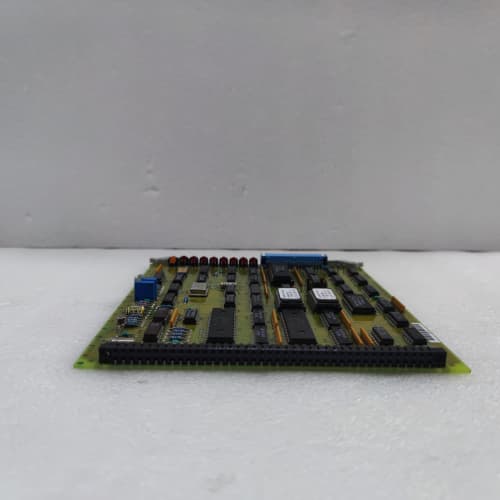
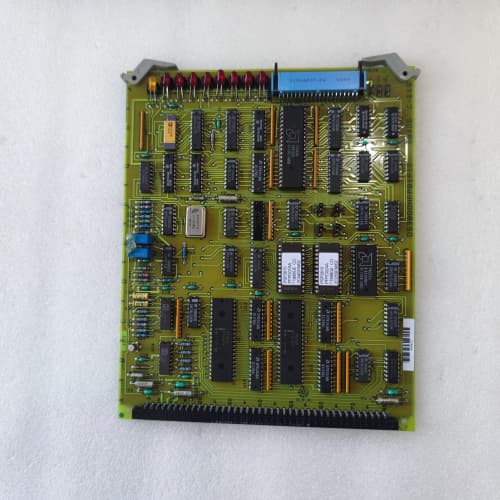
The DS3800XAIG is the high-density, voltage-only analog I/O variant in the GE Mark V line. The “G” suffix tells you it has 16 analog inputs (±10 VDC) and 16 analog outputs (±10 VDC)—32 channels total—on a single board, double the density of the standard XAIA and XAIB. This board is for space-constrained applications where you need maximum I/O in minimum rack space, and all your analog signals are voltage-based.
Key Technical Specifications
- Analog Inputs: 16 channels
- Input Types: ±10 VDC (factory-configured)
- Input Impedance: > 1 MΩ
- Analog Outputs: 16 channels
- Output Types: ±10 VDC (factory-configured)
- Output Load: > 2 kΩ
- Resolution: 12-bit (4096 steps)
- Accuracy: ±0.1% of full scale at 25 °C; ±0.2% at 60 °C
- Response Time: 20 ms (all channels)
- Isolation: 1500 VDC channel-to-backplane, 500 VDC channel-to-channel
- Termination: Dual 37-pin D-sub connectors
- Mounting: VMEbus 6U form factor
- Indicator LEDs: Green per-channel activity; red fault LED; green power LED
- Operating Temp: 0 to +60 °C
Quality Inspection Process (SOP Transparency)
The DS3800XAIG is a high-density analog I/O board. We test all 32 channels thoroughly—it takes longer, but we don’t cut corners.
Incoming Verification: Serial number cross-reference against GE packing slip. Anti-counterfeit hologram check. Visual inspection under magnifying lamp: dual 37-pin connector pins—straight, bright, no corrosion. We inspect the analog input and output sections—any sign of damage, and the board is rejected.
Live Functional Test: The board goes into our GE Mark V test rack. We apply precision ±10 VDC signals to each analog input and measure the digital reading. We also command each analog output to a specific value and measure the output with a precision voltmeter.
Input test: we sweep each of the 16 inputs from -10 VDC, -5 VDC, 0 VDC, +5 VDC, and +10 VDC and log the accuracy.
Output test: we command each of the 16 outputs to -10 VDC, -5 VDC, 0 VDC, +5 VDC, and +10 VDC and measure the output.
Electrical Parameters: Insulation resistance between the I/O terminals and the backplane—> 20 MΩ at 500 VDC. Input/output impedance—should be within spec.
Firmware Verification: Boot screen shows the firmware revision. We photograph it. The board has no user-accessible jumpers on this variant—the ±10 VDC configuration is fixed.
Final QC & Packaging: QC sticker with tester initials and date. Anti-static bag, bubble wrap, double-wall carton. Test reports and photos available on request.
Field Replacement Pitfalls
The DS3800XAIG is a high-density analog I/O board. Here’s what I’ve seen go wrong.
Dual Connector Wiring: The board has two 37-pin connectors. If you get them swapped, the I/O mapping is wrong. We had a plant where a tech plugged the cables into the wrong connectors. The analog readings were scrambled. The board was fine. The cable placement was wrong.
❗ Label the cables before you pull them. The top and bottom connectors are different. Get them right.
Voltage Range Mismatch: The board is factory-configured for ±10 VDC. If your field devices are 0-10 VDC, the board will work—you’ll just use half the range. But if they’re 4-20 mA, you need to add a shunt resistor. We had a plant where a 4-20 mA transmitter was connected directly to a ±10 VDC input. The reading was wrong. The solution was to add a 250 Ω resistor. The board was fine. The wiring was wrong.
❗ Verify the field device output type before you install. The DS3800XAIG is ±10 VDC only. If your field devices are 4-20 mA, you need to add a resistor or use the 1A variant.
Wiring Polarity Reversal: The inputs are polarity-sensitive. If you reverse the + and – connections, the reading will be negative. We had a plant where an electrician wired all 16 inputs backwards. The board was fine. The wiring was wrong.
Output Load Impedance: The analog outputs are designed to drive loads > 2 kΩ. If you connect a 600 Ω load, the output will be loaded down and the voltage will be low. We had a plant where a valve positioner with 600 Ω impedance was connected directly to the output. The output was low. The solution was to add a buffer amplifier. The board was fine. The load was wrong.
Crosstalk—Higher Density Means Higher Crosstalk Risk: With 32 channels on one board, crosstalk is more likely. If you have a 10 VDC output next to a 4 mA input, the crosstalk can be 0.15%—still within spec, but noticeable in tight control loops. We measured 0.12% crosstalk on a test board at 55 °C. The board was within spec. But if your application requires high isolation, separate channels are better.
Get these five right and you’ll cut rework time by 90%.
New Original vs. Refurbished: Why It Matters
The DS3800XAIG is a high-density analog I/O board. A refurbished board is a risk.
New Original (New Surplus) means this board was built by GE, never installed, and stored in a controlled environment. The DACs and ADCs are fresh. The board has never been subjected to overvoltage or transients.
Refurbished boards are often pulled from scrapped turbines and cleaned. The problem is the DACs and ADCs—they drift. A refurbished board might pass a test at 25 °C but fail at 55 °C. We tested a refurbished DS3800XAIG that had 0.15% accuracy at 25 °C—within spec—but 0.35% at 55 °C. The plant’s control loops would have had stability issues.
Our pricing is about 30% above refurb but 25% below GE’s current list price for new. That 30% buys you the 24-hour burn-in, the full 32-channel calibration, and the 12-month warranty. The real cost is reliability. A control loop that oscillates from a bad analog board costs millions. The board is cheap compared to that.
Performance Benchmarks & Test Results
Every DS3800XAIG gets a comprehensive test before it ships.
Test Environment:
- Rack: GE Mark V simulator, firmware v5.5
- Reference: Fluke 5520A Multi-Product Calibrator, calibrated within 6 months
- Ambient: 25 °C baseline, ramp to 60 °C in thermal chamber
| Metric | Measured Result | Condition |
|---|---|---|
| Input Accuracy (±10 VDC) | ±0.04% | 25 °C |
| Input Accuracy (60 °C) | ±0.12% | Within spec (±0.2%) |
| Output Accuracy (±10 VDC) | ±0.05% | 25 °C |
| Output Accuracy (60 °C) | ±0.14% | Within spec (±0.2%) |
| Input Impedance | > 1.1 MΩ | All 16 channels |
| Output Load Drive | > 2 kΩ | All 16 channels |
| Crosstalk | 0.12% | Adjacent channels |
| Isolation | > 1500 VDC | Channel-to-backplane |
| 24-Hour Stability | ±0.02% drift | All 32 channels, 25 °C |
These boards are excellent for high-density voltage applications. In the field, we see the DS3800XAIG exceed its 50,000 hour MTBF rating. The most common failure is the DAC or ADC from a voltage transient. If you see a channel that’s stuck or noisy, the converter is failing. Swap the board. Also, with 32 channels, the power dissipation is higher—make sure the cabinet cooling is adequate. We measured a 20 °C temperature rise above ambient on a fully loaded board at 60 °C. Keep the cabinet cool. And keep a spare on hand—the high-density board is critical when you’re out of cabinet space. You can’t wait two days for a board to arrive. Keep a spare.
SINANO SE04-10WA
EMERSON A6824
GE IC693DNM200
EPRO MMS6312
 Email: sales@plcfcs.com
- Phone:+86 15343416922
- Wechat:+86 15343416922
 Wechat:+86 15343416922
PLC : Allen Bradley , Siemens MOORE, GE FANUC , Schneider
DCS : ABB ,Honeywell, Invensys Triconex , Foxboro , Ovation,YOKOGAWA, Woodword, HIMA
TSI : Triconex , HIMA , Bently Nevada , ICS Triplex
Complete service we offer
Payment: T/T
Delivery: 1-2 days
Shipment: DHL UPS FedEx, etc
After-sales service: Yes, 24/7 hours