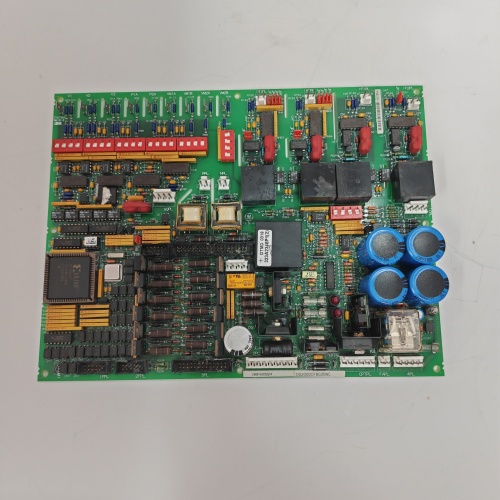
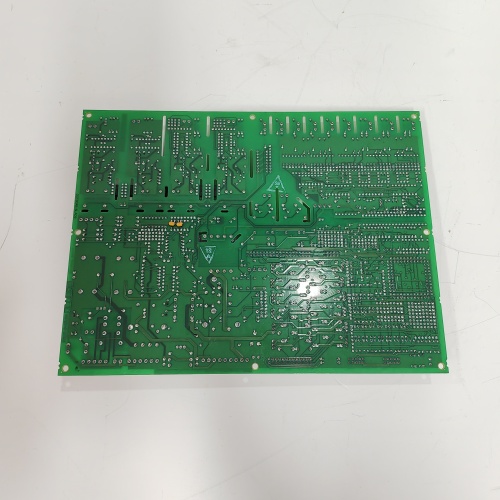
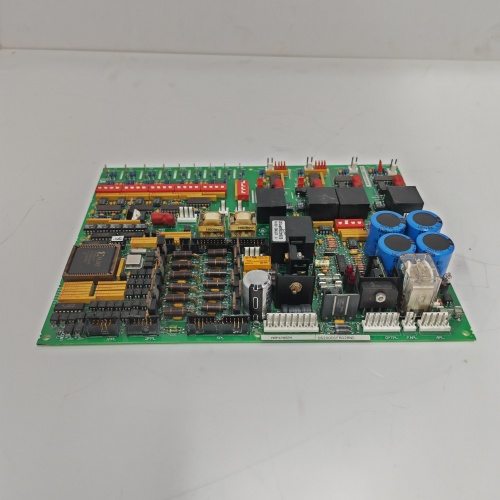
 Email: jiedong@sxrszdh.com
 Phone / Wechat:+86 15340683922
Description
Product Introduction (Anti-Template)
The DS200TCCAG1B represents a significant step forward in analog input technology for the Mark VI platform. While the ‘A’ revision brought 16-bit resolution, the ‘B’ revision adds programmable digital filtering that lets you tune out 50Hz and 60Hz noise—a feature that’s essential when you’re sampling thermocouple signals in a turbine hall full of VFDs and large motors.
Beyond the filtering, the ‘B’ revision also improves the update rate from 10ms to 5ms (200Hz vs. 100Hz) and adds a more stable voltage reference (±5ppm/°C instead of ±10ppm/°C). That’s the difference between a board that drifts by 0.1% over temperature and one that holds 0.05% from 0-60°C. Compared to the TCCAG1A, the ‘B’ gives you faster response, better noise immunity, and tighter thermal stability. If you’re using this board for critical loops (fuel control, steam admission), the ‘B’ revision is a meaningful upgrade that shows up in loop stability—especially when the turbine is ramping and the ambient temperature in the control room is rising.
Key Technical Specifications
| Parameter | Value / Range |
|---|---|
| Manufacturer | General Electric (GE) |
| Part Number | DS200TCCAG1B |
| Board Type | Analog Input Board |
| Number of Channels | 8 (isolated inputs) |
| Input Range | 0-10V, ±10V, 4-20mA (configurable per channel) |
| Resolution | 16-bit (65535 counts) |
| Accuracy | ±0.05% of full scale (at 25°C) |
| Temperature Drift | ±25ppm/°C (improved over ‘A’ revision) |
| Input Impedance | >2MΩ (voltage mode), 250Ω (current mode) |
| Common Mode Rejection | 85dB (DC to 60Hz, with filtering enabled) |
| Digital Filtering | Programmable (50Hz, 60Hz, 250Hz cutoff) |
| Isolation | Channel-to-backplane: 1500Vrms |
| Update Rate | 5ms (all channels sampled simultaneously) |
| Input Power | 24 or 48 VDC (via backplane) |
| Mounting | VME rack (fits standard Mark VI backplane) |
| Operating Temp | 0°C to +60°C |
| Firmware | Version 3.0 or later required (check controller compatibility) |
| Connectors | 1 x 96-pin DIN backplane connector |
Compatible Replacement Models
Replacement options depend on your filtering requirements and update rate needs.
✅ Drop-in Replacement: The DS200TCCAG1A (no ‘B’) is a direct electrical drop-in—same pinout, same 8 channels, same voltage/current ranges. The differences: the ‘A’ version has no digital filtering, a slower update rate (10ms vs. 5ms), and ±0.1% accuracy vs. ±0.05%. If you don’t need the filtering and your update rate requirements are modest, the ‘A’ is a cheaper option. However, if your plant has VFDs or other noise sources, the ‘B’ is worth the premium.
✅ Drop-in Replacement: The DS200TCCAG1 (base model) is also electrically identical—14-bit resolution, ±0.2% accuracy, no filtering, 10ms update. Only use if you’re in a pinch and accuracy/noise requirements are loose.
⚠️ Software Compatible: The DS200TCCAG1C (if available—some suppliers may have a ‘C’ suffix) may require a controller firmware update to support the new filtering options. Always verify firmware compatibility before ordering.
❌ Hardware Incompatible: The DS200TCCBG1A (thermocouple board) uses a different pinout and is designed for millivolt-level signals—not suitable for 0-10V or 4-20mA.
❌ Hardware Incompatible: Any discrete I/O board (TCCX series) uses different backplane pins and is not suitable for analog inputs.
Frequently Asked Questions (FAQ)
What’s the difference between the TCCAG1B and the TCCAG1A?
The ‘B’ revision adds three significant improvements:
- Digital filtering: Programmable 50Hz, 60Hz, or 250Hz cutoff—tunes out power-line noise and VFD harmonics. The ‘A’ version has analog filtering only (fixed 100Hz cutoff).
- Faster update rate: 5ms vs. 10ms—double the update rate, giving you faster response to rapid process changes.
- Better accuracy: ±0.05% vs. ±0.1% full scale, and half the temperature drift (25ppm/°C vs. 50ppm/°C).
The digital filtering is the killer feature—if your plant has large motors or VFDs, the ‘B’ will give you cleaner signals without having to install external filters.
How does the digital filtering work on the ‘B’ revision?
The ‘B’ revision has a programmable digital filter that you configure in ToolboxST (or via the board’s registers). The filter is a finite impulse response (FIR) filter with selectable cutoff frequencies: 50Hz, 60Hz, or 250Hz. If you select 50Hz, the filter removes 50Hz power-line noise and its harmonics. If you select 60Hz, it removes 60Hz noise. The 250Hz setting gives you a wider bandwidth (faster response) with less filtering. The filter also adds a slight delay—about 2ms at 250Hz, 5ms at 60Hz, 6ms at 50Hz. The delay is predictable and consistent, so you can account for it in your control loops.
What update rate can I expect from this board?
The TCCAG1B samples all 8 channels simultaneously at 5ms intervals—200Hz update rate. The ‘A’ revision is 10ms (100Hz). The 5ms update rate is sufficient for the fastest turbine control loops (governor loops typically run at 20-50ms). If you need faster update rates, you’d need a different board—the TCCAG1 series is not designed for high-speed applications. The digital filter adds a slight delay (2-6ms), but the overall update rate remains 5ms—the filter delay is just a phase shift.
Can I use this board with a Mark VIe controller?
No—the TCCAG1B uses the older Mark VI backplane pinout. Mark VIe uses a different assignment and typically uses the IS200TCCAG1B for analog inputs. Use the Mark VIe-specific board for new installations.
How do I test this board before installation?
Testing the ‘B’ revision requires checking the digital filtering functionality:
- Visual inspection: Check for burnt or discolored components. Look for cracked solder joints on the backplane connector. The ‘B’ revision has a slightly different component layout—look for the additional filter chip.
- Power-up test: Install the board in a test rack and apply 24 VDC. The board’s status LED (green) should illuminate within 2 seconds. If the LED is red or flashing, check firmware compatibility.
- Firmware check: Read the firmware version via ToolboxST. It should be 3.0 or later. If it’s not, you may need to update the controller or flash the board.
- Input test – accuracy: Apply a precision 5.00V DC to channel 1. In ToolboxST, read the scaled value—it should be 5.000V ± 0.0025V (0.05% of full scale). Repeat for channels 1-8.
- Input test – current: Apply 12.00mA to a channel configured for 4-20mA. The read value should be 12.000mA ± 0.006mA.
- Filter test: Inject a 60Hz AC signal (1V amplitude) on top of a 5V DC signal into channel 1. Enable the 60Hz digital filter in ToolboxST. The read value should be 5.00V ± 0.01V (the filter should reduce the noise to less than 0.2% of full scale). Disable the filter and verify the noise is visible on the read value.
- Isolation test: Measure the resistance between an input terminal and the board’s ground. Should be >10MΩ.
What’s the most common failure on the ‘B’ revision?
The ‘B’ revision addressed the main failure points of earlier boards, but one new issue appears:
- Digital filter chip failure. The ‘B’ revision uses a programmable digital filter chip (a small FPGA or DSP). If this chip fails, the filtering feature stops working—all channels read with high noise (about 10-20 counts of noise on the raw ADC values). The chip is not user-replaceable. If you see high noise on multiple channels even with the filter enabled, the board needs replacement.
- A/D converter drift. Same as the ‘A’ revision—the 16-bit ADC can drift over time. The ‘B’ revision’s better reference reduces drift, but it’s still possible after 10+ years. The symptom is a consistent offset on all channels. The board may need recalibration or replacement.
If I’m using this board in a SIL-rated safety application, what’s the recommended maintenance interval?
For SIL-2 and SIL-3 applications (IEC 61508), we recommend:
- Visual inspection: Every 6 months
- Power-up test: Every 6 months (verify board boots and LED is green)
- Input accuracy check: Every 6 months (verify each channel reads within 0.05% of a precision source)
- Filter test: Every 12 months (inject noise and verify the filter is working)
- Isolation check: Every 2 years
- Full calibration: Every 5 years
What’s the lead time for a replacement TCCAG1B?
These boards are less common than the ‘A’ revision:
- New surplus: 3-6 weeks. The ‘B’ commands a premium—expect 15-25% above the TCCAG1A.
- Refurbished: 2-3 weeks. Ensure the refurbisher tests the digital filter—some shops only test accuracy and skip the filter functionality.
- Used/as-is: Available but high risk. The digital filter chip is a wear item—used boards may have degraded filtering.
Is there a direct Mark VIe equivalent?
Yes—the IS200TCCAG1B (Mark VIe version). The backplane pinout is different, and the Mark VIe board may have different filtering options. If you’re migrating to Mark VIe, plan to replace all analog boards as part of the rack conversion.
Can I mix TCCAG1B boards with TCCAG1A boards in the same system?
Yes—electrically, they’re compatible. The same pinout and backplane signals. Your control software must be configured to handle the different update rates and filtering options per board. In ToolboxST, you’ll assign each board’s channels to the correct I/O map, and the software automatically handles the different capabilities. The only caveat: if you’re using the 5ms update rate on the ‘B’ boards, make sure your controller can process that fast—older Mark VI controllers (pre-2008) might struggle with the faster sample rate.
How do I configure the digital filter in ToolboxST?
In ToolboxST, navigate to the I/O configuration for the TCCAG1B board. You’ll see a “Filter” tab or dropdown for each channel. Select “50Hz”, “60Hz”, or “250Hz” for each channel. The ‘B’ revision supports independent filter settings per channel—you can have channel 1 with 60Hz filtering, channel 2 with no filtering (250Hz setting effectively disables the filter), etc. The filter setting applies to the ADC reading itself; the scaled engineering value reflects the filtered signal. If you change the filter setting while the board is online, the filter will apply to subsequent samples—no restart is required.
What’s the correct input impedance for current mode?
In current mode (4-20mA), the TCCAG1B uses a 250Ω precision resistor (0.01% tolerance) to convert the current to a voltage. The input impedance in current mode is the resistor value (250Ω), plus a small series resistance. This is lower than the ‘A’ revision (250Ω vs. 250Ω—it’s the same), so there’s no difference. In voltage mode, the ‘B’ revision has a higher input impedance (>2MΩ) than the ‘A’ (>1MΩ), which reduces signal loading on high-impedance sources like LVDTs and potentiometers.
CC-TAIN11 PLC DCS
51304672-150 PLC DCS
CC-TAIX11
 Email: sales@plcfcs.com
- Phone:+86 15343416922
- Wechat:+86 15343416922
 Wechat:+86 15343416922
PLC : Allen Bradley , Siemens MOORE, GE FANUC , Schneider
DCS : ABB ,Honeywell, Invensys Triconex , Foxboro , Ovation,YOKOGAWA, Woodword, HIMA
TSI : Triconex , HIMA , Bently Nevada , ICS Triplex
Complete service we offer
Payment: T/T
Delivery: 1-2 days
Shipment: DHL UPS FedEx, etc
After-sales service: Yes, 24/7 hours