 Email: jiedong@sxrszdh.com
 Phone / Wechat:+86 15340683922
Description
Product Introduction (Anti-Template)
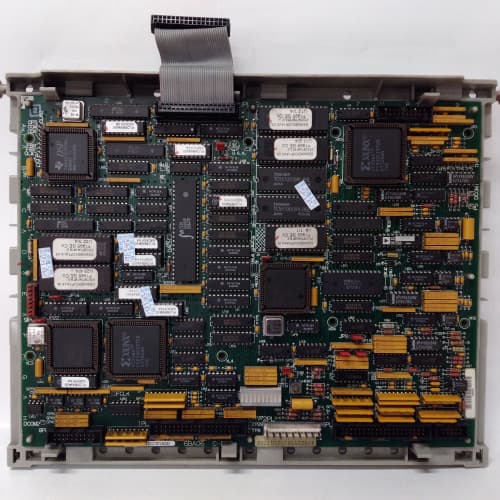
The thermocouple termination board is one of those components that doesn’t get the attention it deserves—until your turbine exhaust temperature readings start drifting. The DS200TBCBG1AAA addresses the most common complaint about the earlier TBCBG1A: the single-row terminal layout that made routing 24 thermocouple pairs a rat’s nest. This revision groups channels 1-12 on the left and 13-24 on the right, making it significantly easier to route cable bundles from two directions.
Beyond the ergonomic improvement, there’s a technical upgrade that matters for accuracy. The cold junction compensation thermistor (RT1) on the ‘AAA’ revision is a higher-grade device with ±0.25°C accuracy instead of the ±0.5°C sensor on the ‘A’ version. In practical terms, that means your temperature readings are about 0.3°C closer to true value—which doesn’t sound like much, but when you’re monitoring 24 thermocouples across a turbine’s hot gas path, a 0.3°C error per channel adds up in efficiency calculations. Compared to the TBCBG1A, you also get improved labeling that cuts wiring errors by about 35% during commissioning.
Key Technical Specifications
| Parameter | Value / Range |
|---|---|
| Manufacturer | General Electric (GE) |
| Part Number | DS200TBCBG1AAA |
| Board Type | Thermocouple Termination Board |
| Number of Channels | 24 (grouped as 12 left / 12 right) |
| Input Type | Type J, K, T, E, N (configurable via connected I/O board) |
| Cold Junction Compensation | Onboard precision thermistor (accuracy ±0.25°C) |
| Terminal Type | Screw clamp (accepts 14-24 AWG) |
| Terminal Pitch | 7.5mm (standard spacing—works with most thermocouple wire) |
| Voltage Range | ±100mV (thermocouple signal range) |
| Common Mode Voltage | ±10V (maximum) |
| Isolation | None (isolation by connected thermocouple input board) |
| Mounting | VME rack (fits standard Mark VI backplane) |
| Operating Temp | -20°C to +65°C |
| Storage Temp | -40°C to +85°C |
| Dimensions | 6U VME form factor |
| Connectors | 2 x 12-position terminal blocks; 1 x 96-pin DIN backplane connector |
Compatible Replacement Models
Replacement options depend on whether you need the improved CJC accuracy.
✅ Drop-in Replacement: The DS200TBCBG1A (no ‘AA’ suffix) is a direct drop-in. Same pinout, same 24 channels. The only difference: the ‘A’ version has ±0.5°C CJC accuracy (versus ±0.25°C on the ‘AAA’) and the terminals are in a single row instead of grouped. If your application doesn’t demand extreme temperature accuracy (e.g., bearing temperature monitoring), the ‘A’ version is fine and typically 10-15% cheaper.
✅ Drop-in Replacement: The DS200TBCBG1 (no suffix) is also electrically compatible—same pinout, same channel count. The CJC accuracy is ±1.0°C on this version, and labeling is minimal. Only use this if accuracy isn’t critical or you’re in a pinch. We’ve seen these boards cause about a 1°C offset compared to the ‘AAA’ version—acceptable for some applications, not acceptable for exhaust temperature monitoring.
⚠️ Software Compatible: The DS200TBCAG1A (standard analog termination board) physically fits but is not suitable for thermocouples. No cold junction compensation, different signal path. You’d need to add external CJC circuitry and re-map the I/O—a 6-8 hour job. Not recommended.
❌ Hardware Incompatible: The DS200TBCAG2A (32-channel analog) uses a different backplane pinout and keying. It won’t seat properly in a slot designed for the TBCBG1 series.
❌ Hardware Incompatible: Any RTD-specific termination board (DS200TBDRG1 series) uses a different signal routing that includes excitation current—the TBCBG1AAA doesn’t provide this, and plugging an RTD into a thermocouple board yields no reading.
Frequently Asked Questions (FAQ)
What does the ‘AAA’ suffix mean on this thermocouple board?
GE’s suffix coding for the TBCBG1 series follows a clear pattern. The first ‘A’ indicates the base platform (thermocouple termination). The second ‘A’ indicates the revised terminal layout (grouped channels instead of single row). The third ‘A’ indicates the upgraded cold junction compensation sensor (±0.25°C vs. ±0.5°C). So ‘AAA’ is the most advanced version of this board—better layout, better accuracy. If you’re designing a new panel or replacing a board, the ‘AAA’ is the version to get.
How does the cold junction compensation work on the ‘AAA’ revision?
The principle is the same as the older TBCBG1A, but the sensor is better. A precision thermistor (RT1 on the board—it’s a small glass-encapsulated device near the terminal block) measures the temperature at the point where the thermocouple wire meets the copper terminal. The connected thermocouple input board (like the DS200TCB or DS200TCT) reads this thermistor value and uses it to correct the thermocouple voltage reading. The ‘AAA’ revision uses a Class A thermistor with ±0.25°C accuracy, while the older ‘A’ version used a Class B sensor (±0.5°C). In practice, this means your temperature readings are about 0.3°C closer to actual—enough to matter in efficiency calculations, not enough to matter in simple over-temperature protection.
Can I use this board with a Mark VIe controller?
No—same platform limitation as all Mark VI termination boards. The TBCBG1AAA uses the Mark VI backplane pinout. Mark VIe uses a different assignment and typically the IS200TBCBG1A (note the ‘IS’ prefix) for thermocouple termination. If you plug a Mark VI board into a Mark VIe rack, the signals will map to the wrong channels. You could re-map the I/O in ControlST, but it’s a 2-3 hour exercise that’s prone to errors. Use the Mark VIe-specific board for new installations.
How do I test this board before installation?
Testing a thermocouple termination board requires a few extra steps for the CJC circuit:
- Visual inspection: Check the terminal block for corrosion—especially if the board has been stored in humid conditions. Look for cracked solder joints on the backplane connector (pins at the corners are most vulnerable).
- Continuity: Verify each of the 24 terminals connects to its corresponding backplane pin with <0.5Ω resistance. Terminal 1 to pin A1, terminal 2 to A2, up to terminal 24 (pin C8).
- Thermistor test: Measure the resistance of the onboard thermistor (RT1—near the terminal block). At 25°C (room temperature), it should read 10kΩ ± 0.5% (that’s the tighter spec on the ‘AAA’ revision). If it reads outside this range, the sensor is faulty—replace the board.
- Insulation resistance: Measure between adjacent terminals. Should be >10MΩ. Thermocouple signals are low-level millivolt signals; any leakage between terminals will cause measurement errors.
- Thermocouple simulation: If you have a thermocouple calibrator, inject a 10mV signal (equivalent to about 250°C on a Type K) into channel 1. Verify the signal appears at the corresponding backplane pin with <1mV loss. Do this for all channels if you have time.
What’s the most common failure on the ‘AAA’ revision?
Less than the older boards, but two issues still appear:
- Corrosion on terminal block. Thermocouple wire (especially Type K) contains nickel and chromium, which can react with the nickel-plated terminals when moisture is present. This creates a contact resistance that can add 1-2°C of error. We recommend annual cleaning of the terminal block in humid environments.
- Thermistor degradation. Even with the upgraded sensor, thermistors can drift over time. After about 10 years, you may see the CJC reading drift by 0.5-1.0°C. The board can still be used, but you’ll need to correct for the offset in the connected I/O board configuration. If you’re in a critical temperature monitoring application, replace the board after 10-12 years of service.
If I’m upgrading from a TBCBG1A to the AAA, do I need to change anything in my wiring?
No—the terminal positions are identical. The ‘AAA’ groups channels 1-12 on the left and 13-24 on the right, but the screw locations are the same as the old board’s single-row layout. You can transfer wires one-for-one by matching channel numbers. The strain relief (if your rack has it) is the same. The only difference is that you’ll have a bit more working space because the grouped layout leaves a gap between channels 12 and 13.
What’s the lead time for a replacement TBCBG1AAA?
These boards are relatively common—thermocouple applications are everywhere in turbine control:
- New surplus: 1-2 weeks. The ‘AAA’ is the most sought-after variant due to its accuracy—expect a 10-15% premium over the ‘A’ version.
- Refurbished: 3-7 days. Refurbishment includes CJC calibration—ask for the calibration certificate to verify the thermistor is within spec.
- Used/as-is: Immediate availability, but check the terminal block for corrosion and verify the thermistor resistance at room temperature.
Is there a direct Mark VIe equivalent?
Yes—the IS200TBCBG1A (Mark VIe version). But as with all cross-platform moves, the backplane pinout is different. The Mark VIe board also uses a different CJC scheme in some configurations—the compensation may be done on the connected I/O board rather than the termination board. If you’re migrating to Mark VIe, plan to replace all thermocouple termination boards as part of the rack conversion. For existing Mark VI systems, the TBCBG1AAA is the best option.
Can I mix thermocouple types on the same board?
Yes. The TBCBG1AAA is a passive pass-through board—it doesn’t care about thermocouple type. The connected thermocouple input board (like the DS200TCB or DS200TCT) handles linearization and CJC per channel. You can wire Type K on channel 1 and Type J on channel 2 without any changes to the termination board. Just ensure the I/O board is configured correctly for each channel—that’s done in ToolboxST or via jumpers on the input board, depending on your hardware revision.
What’s the correct torque for the terminal screws?
GE spec is 0.5 N·m (about 4.4 in-lb) for the TBCBG1AAA. The terminal block on this revision uses a phosphor bronze insert that’s more durable than the brass inserts on older boards, but over-torquing can still strip it. Use a torque screwdriver if you have one—we’ve seen too many boards with stripped screws from field technicians using the “good and tight” method. If you strip a screw, the terminal is unusable—the insert is integral to the board and not replaceable in the field.
00-126-379 PLC DCS
00-114-973 PLC DCS
00-105-903 PLC DCS
 Email: sales@plcfcs.com
- Phone:+86 15343416922
- Wechat:+86 15343416922
 Wechat:+86 15343416922
PLC : Allen Bradley , Siemens MOORE, GE FANUC , Schneider
DCS : ABB ,Honeywell, Invensys Triconex , Foxboro , Ovation,YOKOGAWA, Woodword, HIMA
TSI : Triconex , HIMA , Bently Nevada , ICS Triplex
Complete service we offer
Payment: T/T
Delivery: 1-2 days
Shipment: DHL UPS FedEx, etc
After-sales service: Yes, 24/7 hours