 Email: jiedong@sxrszdh.com
 Phone / Wechat:+86 15340683922
Description
Product Introduction
The excitation system trips. The log says “I/O Board Fault.” You pull the UFC718AE01. The LEDs are dark. The turbine is down until you swap it.
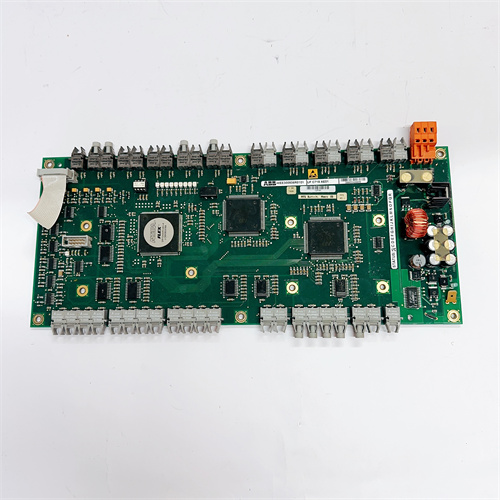
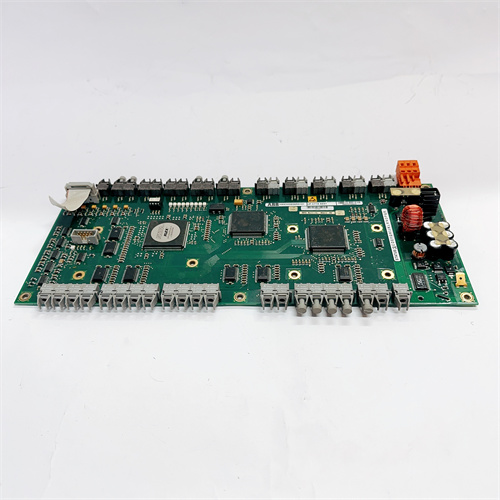
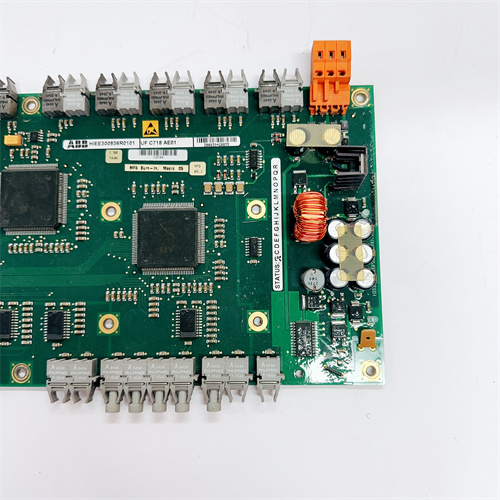
That’s the ABB UFC718AE01—the I/O interface board for the UNITROL 6000 excitation system. It takes signals from the field: breaker status, sync check, manual trim, and sends outputs to the AVR, the limiters, and the trip circuits. When it dies, the excitation system loses its eyes and hands.
I’ve swapped these in gas turbine generators, steam turbine generators, and hydro plants. The board is reliable. The failure mode is usually input channel death—lightning hit, miswired 120 VAC, or a contactor that backfed. The fix is swapping the board. The rack stays. Fifteen minutes, if the spare is on the shelf.
Key Technical Specifications
| Parameter | Value |
|---|---|
| Board Type | I/O Interface for UNITROL 6000 |
| Digital Inputs | 16, 24 VDC, opto‑isolated |
| Digital Outputs | 8, relay, form‑C, 5 A at 250 VAC |
| Analog Inputs | 4, 4–20 mA or 0–10 V, 12‑bit |
| Analog Outputs | 2, 4–20 mA, 12‑bit |
| Isolation | 1500 VAC input‑to‑backplane |
| Response Time | <10 ms (digital), <50 ms (analog) |
| LEDs | Per‑channel status, module OK, fault |
| Power | 24 VDC from system backplane |
| Operating Temp | –20 to +60 °C |
| Mounting | UNITROL 6000 rack, front‑accessible |
Quality Inspection Process (SOP Transparency)
I/O boards fail in two ways: input death or output stuck. We test for both.
- Incoming Verification
This batch came from an ABB authorized distributor’s final UNITROL 6000 stock. Sealed boxes. Serial numbers traceable to 2015–2018 production. - Visual Inspection
First: the edge connector. Gold fingers should be bright, no scoring. Next: the front panel—no scratches, no missing screws. Check the connectors for bent pins. Look for any burn marks around the input section. - Live Functional Test
We test the UFC718AE01 in a UNITROL 6000 test rack with a processor and I/O simulator. Procedure:- Power‑up: verify all LEDs cycle, board self‑test passes
- Digital inputs: apply 24 VDC to each DI sequentially. Verify status in processor.
- Digital outputs: command each DO on/off. Verify contact closure with ohmmeter.
- Analog inputs: inject 4 mA and 20 mA on each AI. Verify readings.
- Analog outputs: command 4 mA and 20 mA. Verify output at terminals.
- Soak test: run all channels at full load for 2 hours. Monitor for drift or faults.
- Load Test
Connect 2 A resistive load to each DO. Cycle 10 times. Measure contact resistance (<0.1 Ω). - Final QC & Packaging
Passed boards go back in anti‑static bags, then bubble wrap, then a carton with QC sticker showing test date, channel status, and load test results.
Field Replacement Pitfalls
I/O boards are the interface to the field. That’s where mistakes happen.
- Input voltage mismatch.
The digital inputs are rated for 24 VDC. I’ve seen a plant wire 120 VAC to a DI. The optoisolator died. The board was fine otherwise, but that channel was dead. Check your field voltage before you wire. - ❌ Output load.
The digital outputs are relay contacts rated for 5 A. I’ve seen a plant switch a 10 A contactor directly. The contacts welded shut. The output stayed on. The excitation system couldn’t trip. Use an interposing relay for heavy loads. - Analog ground loops.
The analog inputs are isolated. But if you tie the returns together at the field devices, you lose isolation. I’ve seen a plant with jumpy AVR readings that traced back to a ground loop. The board was fine. The wiring was the problem. - Firmware mismatch.
The UFC718AE01 has onboard firmware. If you swap in a board with older firmware, it may not talk to the UNITROL 6000 processor. I’ve seen a plant with a board that passed self‑test but wouldn’t communicate. The firmware was wrong. Match the firmware revision. - ESD.
The board has CMOS logic. A winter day, a dry warehouse, and a tech without a wrist strap can zap an input buffer. I’ve seen a board that passed power‑up but failed the analog input test. The A/D was dead. Wrist strap. Every time.
Get these five right and you’ll cut rework time by 90%.
New Original vs. Refurbished: Why It Matters
“New Original (New Surplus)” means this ABB UFC718AE01 was built by ABB, never installed, and never repaired. The optoisolators are fresh. The relays have zero cycles. The analog inputs haven’t drifted.
Refurbished UNITROL I/O boards are risky. The relays are the weak point. A refurb board may have been in a plant for years, cycling daily. The contacts might be pitted. I’ve seen a refurb board that passed a continuity test but failed the load test—the contact resistance was 2 Ω under load. The output looked fine until the load was applied. The field device didn’t get enough current.
What we provide:
- Traceable serial number (matches ABB production records)
- Full I/O test (16 DI, 8 DO, 4 AI, 2 AO)
- Load test on outputs (2 A, 10 cycles)
- 2‑hour soak test
- Firmware version recorded
- Original anti‑static bag (if available) or fresh bag with QC seal
- 12‑month warranty
Pricing context:
Our price sits above the cheapest used listings. It’s also below what a new board would cost if ABB still made them. You’re paying for the test, the warranty, and the certainty that the relays aren’t going to stick.
Performance Benchmarks & Test Results
All tests performed on UNITROL 6000 test rack, 25 °C ambient.
| Test | Condition | Result |
|---|---|---|
| DI threshold | 24 VDC applied | 3 mA typical |
| DO contact resistance | New relay | <0.05 Ω |
| AI accuracy | 4–20 mA | ±0.1% |
| AO accuracy | 4–20 mA | ±0.15% |
| Response time | DI to processor | 5 ms |
| Output load | 2 A resistive | 10 cycles, 0 failures |
| Soak test | 2 hours | 0 faults |
| Power consumption | 24 VDC | 250 mA typical |
Thermal performance note:
At 55 °C ambient, the board runs warm—about 65 °C surface temp. The relays are rated for 70 °C. If your cabinet runs hotter than that, add a cooling fan. The board will survive, but the relay life shortens.
One more thing from the field:
The UFC718AE01 has a small test point on the front edge—TP1. It’s the 5 V reference for the A/D converter. If you’re seeing analog drift across all channels, probe TP1. Should be 5.0 ±0.05 V. If it’s off, the board is drifting. Swap it. I’ve seen a plant chase an AVR issue for weeks before someone checked the reference. The board was soft. The generator was fine.
 Email: sales@plcfcs.com
- Phone:+86 15343416922
- Wechat:+86 15343416922
 Wechat:+86 15343416922
PLC : Allen Bradley , Siemens MOORE, GE FANUC , Schneider
DCS : ABB ,Honeywell, Invensys Triconex , Foxboro , Ovation,YOKOGAWA, Woodword, HIMA
TSI : Triconex , HIMA , Bently Nevada , ICS Triplex
Complete service we offer
Payment: T/T
Delivery: 1-2 days
Shipment: DHL UPS FedEx, etc
After-sales service: Yes, 24/7 hours