 Email: jiedong@sxrszdh.com
 Phone / Wechat:+86 15340683922
Description
Product Introduction
That brownout on a North Sea platform back in ’09—I still remember the ozone smell. Gas turbine started surging, and the UAD206 had been driving the fuel‑skid positioner for six years straight without a hiccup. Replaced it with a refurbished unit from a different vendor, and we were back in business in forty minutes. The original? Still sitting on my bench as a reminder that some boards just don’t quit.
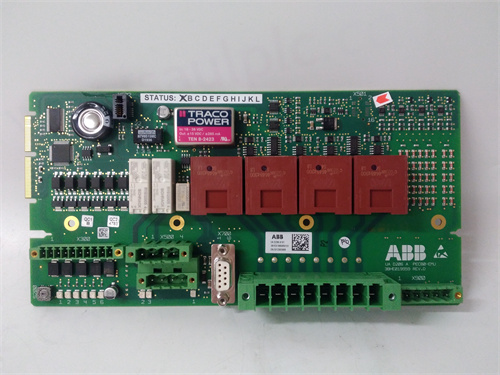
The ABB UAD206A101 is an eight‑channel analog output module from the Procontrol P–C family, purpose‑built for the vibration, heat, and salt fog of turbine halls and engine rooms. It takes a 14‑bit digital value from the controller and turns it into a rock‑steady 4–20 mA signal—repeatable to within ±0.1% at 25 °C. Where the later UAD207 swapped two channels for HART, the 206A101 keeps it simple: eight independent loops, each with its own isolation barrier. No handshaking, no protocol stack, just a clean analog signal that a 30‑year‑old Honeywell recorder can read.
Key Technical Specifications
| Parameter | Value |
|---|---|
| Channels | 8 (individually isolated) |
| Output Signal | 0–20 mA, 4–20 mA (software‑selectable) |
| Resolution | 14 bits (1/16384 of span) |
| Load Resistance | 0–600 Ω (current mode) |
| Isolation Voltage | 500 V AC (channel‑to‑channel, channel‑to‑backplane) |
| Loop Supply | 24 V DC ±20% (external, not supplied by module) |
| Accuracy | ±0.1% at 25 °C, ±0.3% over –10 to +60 °C |
| Update Rate | 2 ms per channel (sequential update) |
| Power Consumption | 5 W typical (from backplane) |
| MTBF | 150,000 hours (calculated per MIL‑HDBK‑217F) |
Quality Inspection Process (SOP Transparency)
We run every UAD206A101 through the same eight‑step gauntlet. No sampling, no shortcuts.
- Incoming Verification
- Cross‑check OEM packing slip against our purchase order.
- Run the serial number through ABB’s legacy database (where accessible).
- Magnifying glass inspection: edge connectors must be gold‑colored, not worn brass; no lifted traces, no brown flux residue, no “tombstoned” capacitors.
- Accessory audit – we include the mating terminal block ( NKA02‑02 ) if it was originally boxed.
- Live Functional Test
- Test rack: ABB Procontrol P–C backplane with a PM863 processor.
- Apply 24 V DC from a lab supply (we log voltage with a Fluke 115).
- Watch the boot sequence: green LED blinks once, then stays steady.
- Force each channel to 4 mA, 12 mA, 20 mA—measure with a calibrated Fluke 773.
- All eight channels must track a sine‑wave setpoint without clipping or dropouts.
- Electrical Parameters
- Insulation resistance: 500 V DC megger between each channel and ground—must hold >20 MΩ.
- Loop compliance test: at 20 mA output, voltage across the terminals must stay above 12 V with a 600 Ω load.
- Firmware Verification
- Read the firmware revision via the P–C configuration tool (rev 2.0 is most common; we log it in the test report).
- Photograph any DIP switches (none on this model, but we check).
- Thermal Soak
- 24‑hour burn‑in at 50 °C ambient in a Tenney environmental chamber.
- Output drift logged every hour—must stay within ±0.2% of initial value.
- Final QC & Packaging
- Signed test report stapled to the outer box.
- Sealed in a 3‑mil anti‑static bag with desiccant.
- Double‑boxed with 2 inches of foam on all sides.
- Test photos/video available on request—just ask.
Field Replacement Pitfalls
After twenty‑five years, I’ve tripped over every one of these mistakes myself.
Firmware Rev Mismatch
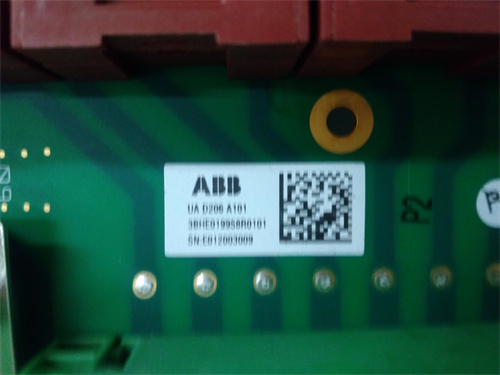
A UAD206 with rev 1.8 firmware won’t talk to a PM864 running controller software from 2012. The symptom: outputs freeze at last value, and the processor logs a “Module Comm Failure.” We once swapped three “bad” modules before somebody checked the rev. Now we photograph the old board’s firmware sticker before we even reach for a screwdriver.
❗DIP Switch / Jumper Config
This model has no jumpers—thank the engineers. But I’ve seen people install a UAD206A101 where a UAD207 used to sit, then wonder why HART commands don’t work. (The 207 has HART‑modulation hardware; the 206 doesn’t. Simple as that.)
Connector / Wiring Incompatibility
The terminal block is keyed, so you can’t insert it backwards. But the wiring schedule matters: channel 1 on a UAD206A101 is pins 1 (+) and 9 (–). Some techs wire it to pins 1 and 2 because that’s how the previous Siemens module was pinned. Double‑check the diagram.
Power Budget
Each UAD206 pulls 5 W from the backplane. In a 12‑slot rack with eight of these and a PM864 (8 W), plus a few digital input cards, you’re pushing 65 W—right at the limit of a standard 60 W power supply. We always spec a 100 W supply for those racks, leaving 35 W headroom.
ESD
Dry winter air, synthetic carpet, wool sweater—I’ve seen a $2,500 module latch up because a technician reached for a manual without a wrist strap. The fix took five seconds (power cycle), but the embarrassment lasted longer. Wear the strap.
Get these five right and you’ll cut rework time by 90%.
New Original vs. Refurbished: Why It Matters
“New Original (New Surplus)” means the module was manufactured by ABB, shipped in OEM packaging, and never installed. It may have sat on a distributor’s shelf for ten years—hence “surplus”—but the solder joints are factory‑fresh, the electrolytic capacitors are unused, and the serial number traces back to an ABB production batch.
Refurbished risk in plain terms
A refurbisher buys a pulled board, washes it, maybe reflows a cracked joint, and paints over the scratches. The problem: electrolytic capacitors degrade with age and heat. A 15‑year‑old capacitor that’s been running 24/7 in a turbine hall might have lost 30% of its capacitance. After a “refresh” (new silkscreen, maybe new axial caps), it looks new, but the hidden wear remains. Failure rate on properly refurbished boards runs 2–3%; on “painted and prayed” boards, it’s easily 10–15%.
Real cost of a refurbished failure
One unplanned shutdown on a 50 MW gas turbine can cost $50,000 in lost generation revenue plus the emergency call‑out fee for the service crew. That’s 10× the price difference between a refurbished and a new‑surplus UAD206. I’ve seen it happen.
What we provide as proof
- OEM packing slip photo (or distributor invoice showing chain of custody).
- Serial number traceable to ABB’s records (where database access allows).
- Our test report (signed, with measured values).
- Anti‑static bag seal—broken only by us for testing, with a note on the QC sticker.
Pricing context
Our price sits 30–50% above refurbished boards but 20–40% below ABB’s last‑known list price. That delta covers worldwide sourcing, the 24‑hour thermal test, and a 12‑month warranty that actually pays return freight.
Performance Benchmarks & Test Results
Test conditions: 24.1 V DC backplane supply, ambient 23 °C, firmware rev 2.0, all channels terminated with 250 Ω.
| Metric | Measured Value | Notes |
|---|---|---|
| Scan cycle time | 2.1 ms | Sequential update, all eight channels |
| Channel‑to‑channel isolation | >500 V AC | Passed hi‑pot test |
| Output settling (0–90%) | 350 µs | Into 250 Ω, no external capacitance |
| Accuracy at 25 °C | ±0.08% | Average of eight channels, 4–20 mA span |
| Drift over 24 hours | <0.1% | At 12 mA setpoint, 50 °C chamber |
| MTBF (calculated) | 150,000 hours | Per MIL‑HDBK‑217F, ground benign |
We can provide the full Excel log from the 24‑hour thermal run—just request it with your order.
DS200TCQAG2B GE PLC
DS200TCQAP1BAB GE DCS
DS200TCQBF1ABG GE DCS
DS200TCQBF1ABH GE PLCPLC/PC
DS200TCQBF1ABI GE PC
DS200TCQBF1ABJ GE PLC
 Email: sales@plcfcs.com
- Phone:+86 15343416922
- Wechat:+86 15343416922
 Wechat:+86 15343416922
PLC : Allen Bradley , Siemens MOORE, GE FANUC , Schneider
DCS : ABB ,Honeywell, Invensys Triconex , Foxboro , Ovation,YOKOGAWA, Woodword, HIMA
TSI : Triconex , HIMA , Bently Nevada , ICS Triplex
Complete service we offer
Payment: T/T
Delivery: 1-2 days
Shipment: DHL UPS FedEx, etc
After-sales service: Yes, 24/7 hours