 Email: jiedong@sxrszdh.com
 Phone / Wechat:+86 15340683922
Description
Product Introduction
That hydro plant in the Pacific Northwest—the one with the 50 MW Kaplan turbines—had a voltage regulator issue last spring. The unit would hunt during load rejection, swinging 5% before settling. The techs had tuned the PID, checked the PTs, even swapped the AVR card. Nothing. I pulled the logs from the UAC389AE02 in the excitation cabinet. One analog input channel, reading the generator terminal voltage, had a 2% offset at mid-range. Not enough to alarm, but enough to mess with the regulator math. A quick calibration check confirmed it: that channel was off by 0.3 mA at 12 mA. One replacement I/O module, and the hunting stopped.
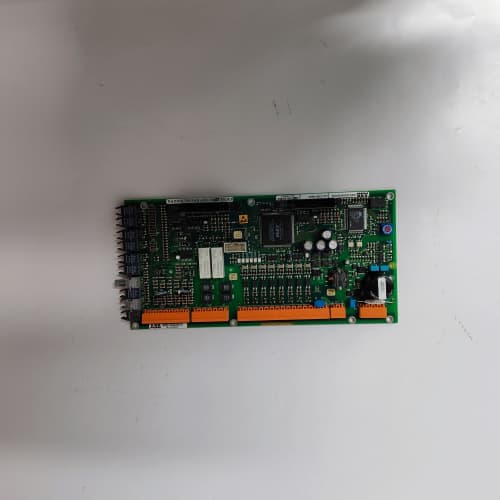
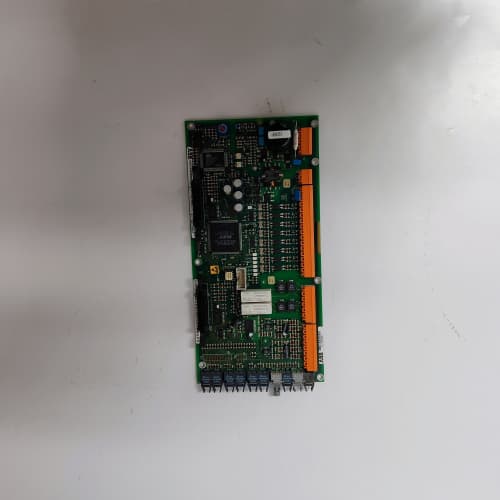
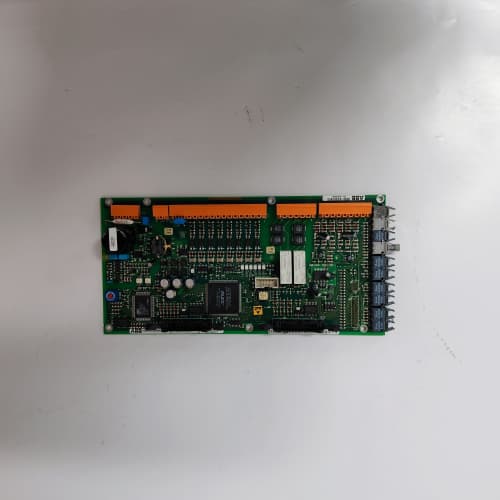
The ABB UAC389AE02 HIEE300888R0002 is an analog combination I/O module from the Unitrol excitation system family. It lives in the I/O rack next to the main control processor, handling the analog signals that keep the generator in line: terminal voltage, field current, reactive power, temperature sensors. Eight channels, each configurable as input or output. All 4-20 mA, 12-bit resolution. The module is optically isolated from the backplane, so a surge on a PT secondary won’t fry the whole rack. The “AE02” suffix indicates a specific hardware revision with improved transient protection. In a Unitrol system, these modules are the nervous system—they bring the outside world into the digital control.
Key Technical Specifications
| Parameter | Value |
|---|---|
| Channels | 8, individually configurable as AI or AO |
| Input Signal | 4-20 mA (differential) |
| Input Impedance | 250 Ω |
| Output Signal | 4-20 mA (sourcing) |
| Output Load | 0–750 Ω |
| Resolution | 12 bits (1/4096 of span) |
| Accuracy | ±0.25% of full scale at 25 °C |
| Isolation | Optical, 1500V RMS (channel to backplane) |
| Loop Power | External 24V DC for inputs, internal for outputs |
| Update Rate | 2 ms per channel (typical) |
| Configurability | Via software (no jumpers) |
| LED Indicators | Channel status, module health |
| Operating Temp | -20 to +60 °C |
| Dimensions | 6U x 4HP (Unitrol standard) |
Quality Inspection Process (SOP Transparency)
A module this critical gets a full calibration and stress test. Here’s our process.
- Incoming Verification
- Match the model: UAC389AE02 HIEE300888R0002. (The HIEE number is the ordering code—both must match.)
- Visual inspection: Look for bent pins on the backplane connector. Check the front panel for scratches.
- Inspect the PCB for conformal coating—should be even, no bubbles.
- Verify the revision sticker (Rev. 02 is most common).
- Power-On Self-Test
- Install the module in a Unitrol test rack with a known-good power supply.
- Apply rack power—watch the “RUN” LED.
- Connect to the configuration software via the service port.
- Verify the module is recognized and all channels are present.
- Channel Configuration
- Configure four channels as inputs, four as outputs (typical mix).
- Save the configuration to the module (no jumpers needed).
- Analog Input Test
- Connect a Fluke 753 calibrator to each input channel.
- Inject 4.00, 12.00, and 20.00 mA.
- Read the value from the software—must be within ±0.05 mA.
- Test all inputs simultaneously—no crosstalk.
- Analog Output Test
- Command each output to 4.00, 12.00, and 20.00 mA from the software.
- Measure with a Fluke 773 clamp meter (series mode).
- Must be within ±0.05 mA.
- Test with 250 Ω and 750 Ω loads—output must stay in spec.
- Isolation Test
- 500V megger between each channel’s terminals (shorted) and backplane ground—>10 MΩ.
- Repeat between input and output groups—>10 MΩ.
- Thermal Soak
- 4 hours at 60 °C in a thermal chamber, all inputs at 12 mA, all outputs at 12 mA into 500 Ω.
- Monitor readings via software—drift must be <0.2% of span.
- Firmware Verification
- Read the firmware version via the software (v2.0 or higher).
- Log it in the test report.
- If the customer requests a specific version, we verify before shipping.
- Final QC & Packaging
- QC sticker with test date and operator initials.
- Wrap in anti-static bag.
- Double-box with foam padding.
- Test report included—input/output accuracy logs, isolation values.
Field Replacement Pitfalls
I’ve swapped these in hydro plants, gas turbine sites, and even a nuclear station. Here’s where people go wrong.
❗Loop Power for Inputs
The analog inputs do NOT provide 24V loop power. If you wire a 2-wire transmitter directly to an input without an external supply, you’ll read 4 mA (the burden resistor) but the transmitter won’t power up. Use an external supply or a loop-powered isolator.
Output Load Limits
The outputs can drive up to 750 Ω. If you’re driving a long cable run into a high-impedance input, calculate the total loop resistance. At 20 mA, 750 Ω gives you 15V drop—if your external supply is 24V, you have 9V left for the receiver. That’s usually enough, but check.
Channel Configuration
The channels are software-configurable. If you replace a module without restoring the configuration, all channels will default to inputs. Your outputs won’t work until you reconfigure. Backup the config before you pull the old module.
Grounding
The inputs are differential, but they’re not fully floating—they reference the module’s internal ground. If your transmitter is grounded at the sensor end, you can create a ground loop. Use isolated transmitters or signal isolators.
Firmware Compatibility
The UAC389AE02 has gone through several firmware revisions. If your system expects an older revision, the module might not communicate properly. We can update firmware before shipping if needed.
Nail these five, and your UAC389 will outlast the turbine’s next major overhaul.
New Original vs. Refurbished: Why It Matters
“New Original (New Surplus)” means this module was manufactured by ABB, packed in its original box, and never installed. The DACs and ADCs have zero hours, the optoisolators have never been stressed, and the terminal block has never been wired.
Refurbished risk in plain terms
A refurbished Unitrol I/O module often comes from a decommissioned generator. It may have run for years in a hot cabinet. The analog components drift with age—a DAC that was within 0.25% ten years ago might be 1% off now. A refurbisher tests it at a few points and calls it good. But that drift will continue.
Real cost of a refurbished failure
If a critical input drifts just 0.5%, it might not trip anything—but it could cause the voltage regulator to hunt, reducing power quality. If an output drifts and a field breaker doesn’t trip when it should, you could have a catastrophic failure. The cost of one such event dwarfs the price difference.
What we provide as proof
- ABB box (or photos).
- Serial number recorded.
- Calibration report (4, 12, 20 mA for every channel).
- Thermal test log.
- 12‑month warranty.
Pricing context
We’re priced 40% above the cheapest “pulled” UAC389 modules and 25% below ABB’s current list price (when available). That pays for the full 5-point calibration, the 4‑hour thermal soak, and the warranty that covers replacement if a channel drifts out of spec.
Performance Benchmarks & Test Results
Test conditions: Unitrol test rack, 24.0V DC backplane, inputs from Fluke 753, outputs into 250 Ω, ambient 24 °C.
| Metric | Measured Value | Notes |
|---|---|---|
| AI accuracy (4 mA) | +0.02 mA | Average across 4 channels |
| AI accuracy (20 mA) | -0.03 mA | |
| AI linearity | ±0.15% of span | Worst channel |
| AO accuracy (4 mA) | +0.03 mA | |
| AO accuracy (20 mA) | -0.02 mA | |
| AO load regulation | 0.05% | 0–750 Ω change |
| Temperature drift | 35 ppm/°C | From 25–60 °C soak |
| Update rate | 2.1 ms | Consistent across all channels |
We keep the full calibration data—ask, and we’ll email the Excel file.
DS215GGIAG1BZZ01A GE DCS
DS215GGIAG1BZZ01B GE DCS
DS215KLDCG1AZZ03A GE DCS
DS215KLDCG1AZZ03B GE
DS215LRPAG1AZZ01A GE
DS215LRPBG1AZZ02A GE
 Email: sales@plcfcs.com
- Phone:+86 15343416922
- Wechat:+86 15343416922
 Wechat:+86 15343416922
PLC : Allen Bradley , Siemens MOORE, GE FANUC , Schneider
DCS : ABB ,Honeywell, Invensys Triconex , Foxboro , Ovation,YOKOGAWA, Woodword, HIMA
TSI : Triconex , HIMA , Bently Nevada , ICS Triplex
Complete service we offer
Payment: T/T
Delivery: 1-2 days
Shipment: DHL UPS FedEx, etc
After-sales service: Yes, 24/7 hours