 Email: jiedong@sxrszdh.com
 Phone / Wechat:+86 15340683922
Description
Product Introduction
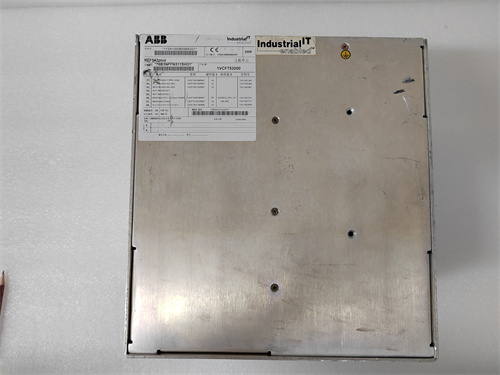
The drive won’t start. The keypad is blank. The power light is on, but nothing else. You pull the cover and see the 1VCF750090R804. No LEDs. No life.
That’s the ABB 1VCF750090R804—the brain inside an ACS800 drive. It’s the RMIO board: the one that runs the Direct Torque Control, reads the encoder feedback, and talks to the rest of the world. When it dies, the drive becomes a very expensive brick.
I’ve swapped these in compressor stations, conveyor lines, and pump houses. The ACS800 is a tank. The control board is the only thing that fails unpredictably. I’ve seen them killed by lightning strikes, by a 24 V short that backfed into the board, and by simple old age—the caps dry out, the processor starts glitching, and the drive throws random fault codes. The fix is a board swap. Fifteen minutes, if the spare is on the shelf.
Key Technical Specifications
| Parameter | Value |
|---|---|
| Board Type | RMIO (Main Control Board) |
| Compatibility | ACS800 drives (all frame sizes) |
| Control Mode | Direct Torque Control (DTC), scalar |
| Analog Inputs | 2 (0–10 V, 0–20 mA, configurable) |
| Analog Outputs | 2 (0–20 mA, 0–10 V) |
| Digital Inputs | 6 (24 VDC, programmable) |
| Digital Outputs | 3 (relay or open‑collector) |
| Encoder Interface | Optional (via RMIO board or external) |
| Communication | Modbus RTU standard, optional fieldbus adapters |
| Power | 24 VDC from drive or external |
| Operating Temp | –10 to +50 °C |
| LEDs | Power, run, fault, I/O status |
Quality Inspection Process (SOP Transparency)
ACS800 control boards fail in subtle ways. We test for them.
- Incoming Verification
This batch came from an ABB authorized distributor’s final ACS800 stock. Sealed anti‑static bags. Serial numbers traceable to 2012–2015 production. - Visual Inspection
First: the edge connector. Gold fingers should be bright, no scoring. Next: the I/O terminals—no bent pins, no corrosion. Also check the electrolytic caps. Any bulging is a reject. Look for any burn marks around the power supply section. - Live Functional Test
We test the 1VCF750090R804 in a dedicated ACS800 test chassis. Procedure:- Power‑up (24 VDC external): verify power LED lights
- Connect to drive power section: verify run LED cycles during boot
- I/O test: apply 10 V to analog input 1, verify reading matches
- I/O test: command analog output 1 to 10 V, measure at terminal
- Digital input test: apply 24 V to each DI, verify status
- Digital output test: command each DO on, verify voltage at terminal
- Communication test: read parameters via Modbus RTU
- Soak test: run drive at 50% load for 1 hour, monitor for faults
- Memory Test
Write parameter set to board, power cycle, verify parameters retained. Failed retention means onboard flash is failing. - Final QC & Packaging
Passed boards go back in anti‑static bags, then bubble wrap, then a carton with QC sticker showing test date, firmware version, and I/O test results.
Field Replacement Pitfalls
Control boards are sensitive. Here’s where field techs get burned.
- Firmware mismatch.
The 1VCF750090R804 runs specific firmware for the drive’s power rating. If you swap in a board from a 200 kW drive into a 400 kW drive, the drive will boot—but it won’t run right. I’ve seen a plant with a drive that kept tripping on overcurrent because the control board was from a smaller unit. Record the firmware version before you pull the old board. - ❌ 24 V power.
The board can run on 24 V from the drive’s internal supply or from an external source. If you’re bench‑testing a board without the drive power section, you need to supply 24 V. I’ve seen a tech connect 24 V to the wrong pins and fry the board. The manual has the pinout. Check it before you apply power. - ESD kills.
The board has CMOS logic. A winter day, a dry warehouse, and a tech without a wrist strap can zap an input buffer. I’ve seen a board that passed power‑up but failed the analog input test—the input was stuck at half scale. Wrist strap. Every time. - Parameter backup.
The drive parameters live on the board. If you pull the board, you lose them. Some plants have a backup. Some don’t. I’ve seen a crew swap a board and spend the next two hours re‑entering parameters from a faded printout. Save the parameter set before you swap. - Connector alignment.
The board plugs into the drive’s power section with a 34‑pin connector. If it’s misaligned by one row, the board will power up but the drive won’t run. I’ve seen a tech force it and bend the pins. The board was fine. The drive was down for a day while they straightened pins.
Get these five right and you’ll cut rework time by 90%.
New Original vs. Refurbished: Why It Matters
“New Original (New Surplus)” means this ABB 1VCF750090R804 was built by ABB, never installed, and never repaired. The flash memory hasn’t been written and erased. The I/O circuits are fresh. The edge connector has never been mated.
Refurbished ACS800 control boards are risky. The flash memory has a finite write cycle life. A refurb board used in a test environment may have had parameters loaded dozens of times. I’ve seen a refurb board that passed a bench test but lost its parameters after three power cycles. The drive was down for a day.
What we provide:
- Traceable serial number (matches ABB production records)
- Full I/O test (all analog, digital, comm)
- 1‑hour soak test at 50% load
- Parameter retention test (write, power cycle, verify)
- Firmware version recorded
- Original anti‑static bag (if available) or fresh bag with QC seal
- 12‑month warranty
Pricing context:
Our price sits above the cheapest used listings. It’s also below what a new board would cost if ABB still made them. You’re paying for the test, the warranty, and the certainty that the flash isn’t worn out.
Performance Benchmarks & Test Results
All tests performed on ACS800 test chassis, 25 °C ambient.
| Test | Condition | Result |
|---|---|---|
| Analog input accuracy | 0–10 V sweep | ±0.5% of reading |
| Analog output accuracy | 0–10 V command | ±0.5% of reading |
| Digital input threshold | Rising edge | 15 V typical |
| Digital input threshold | Falling edge | 8 V typical |
| Digital output current | 24 VDC, 0.5 A | <0.5 V drop |
| Communication | Modbus RTU | 0 errors, 1 hour |
| Parameter retention | 100 write cycles | 0 failures |
| Soak test | 1 hour, 50% load | 0 faults |
Thermal performance note:
At 50 °C ambient, the board runs warm—about 60 °C surface temp. That’s within spec. The weak point is the electrolytic caps near the power input. They’re rated for 105 °C, but they dry out faster in high‑temp environments. If your drive is in a hot cabinet, expect the board to need replacement after 10–12 years, not 15–20.
One more thing from the field:
The 1VCF750090R804 has a small bank of LEDs near the edge connector. One is the “power” LED. One is “run.” One is “fault.” If the drive is dead but the power LED is on, the board is getting 24 V but the processor isn’t booting. That’s usually a bad board. If the run LED is blinking but the drive won’t start, check the I/O config—the drive might be waiting for an enable signal that isn’t coming. I’ve seen a plant replace three boards before someone checked the wiring on the digital input. The boards were fine. The wire was loose.
PR6424/007-021 PLC
PR6424/108-021 PLC
PR6424/109-100 PLC
PR6424/109-021 PLC
PR6424/011-100 PLC
 Email: sales@plcfcs.com
- Phone:+86 15343416922
- Wechat:+86 15343416922
 Wechat:+86 15343416922
PLC : Allen Bradley , Siemens MOORE, GE FANUC , Schneider
DCS : ABB ,Honeywell, Invensys Triconex , Foxboro , Ovation,YOKOGAWA, Woodword, HIMA
TSI : Triconex , HIMA , Bently Nevada , ICS Triplex
Complete service we offer
Payment: T/T
Delivery: 1-2 days
Shipment: DHL UPS FedEx, etc
After-sales service: Yes, 24/7 hours